How to Set Markup and Pricing as a B2B Travel Agent
Written by the Rayds team · Updated
Getting travel agent markup pricing right is one of the biggest levers on your profitability as a B2B travel agent. Price too high and your sub-agents or partner agencies buy elsewhere. Price too low and you work hard for thin margins, or lose money once costs and cancellations hit.
We build B2B travel portals at Rayds, including a white label travel portal, where markup rules are one of the first things agents configure. This guide covers how to set markups, which pricing models work in B2B, and how to stay competitive without giving away your profit.
The short answer
Work out your true cost per booking, decide the margin you need, then add a markup that delivers it. Use different rules for different products (flat fees for visas, lower percentages for flights, higher for packages), tier your partners by volume, and leave enough room for your partner to add their own markup and still stay competitive. Cover your handling effort and payment costs with clearly disclosed service fees and convenience fees, rather than hiding them inside the price.
Markup vs. Margin: Know the Difference First
These two terms are often confused, and the confusion causes real pricing errors.
- Markup is the percentage added to your cost. Formula: (Selling price − Cost) ÷ Cost × 100
- Margin is the percentage of the selling price you keep as profit. Formula: (Selling price − Cost) ÷ Selling price × 100
Example: a hotel room costs you ₹10,000 and you sell it for ₹12,000.
- Markup = (2,000 ÷ 10,000) × 100 = 20%
- Margin = (2,000 ÷ 12,000) × 100 = 16.7%
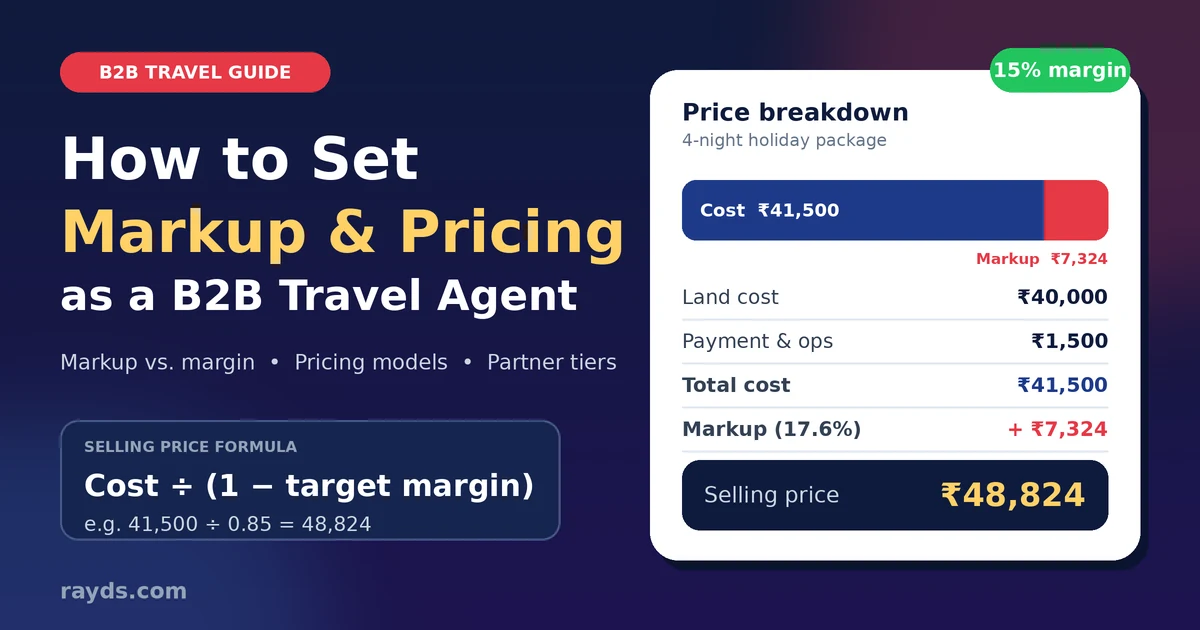
A 20% markup does not give you a 20% margin. If you need a specific margin, work backwards: Selling price = Cost ÷ (1 − target margin). For a 20% margin on a ₹10,000 cost, sell at ₹12,500.
Step 1: Calculate Your True Cost Base
Your markup has to cover more than the supplier's net rate. Before setting any percentage, add up what it costs you to deliver the booking:
- Supplier net rate (hotel, airline, transfer, tour operator or DMC)
- Payment gateway and bank charges
- Currency conversion costs and exchange-rate risk
- Platform, API or GDS fees
- Staff time for quoting, amendments and support
- Cancellation and refund risk
- Taxes such as GST and TCS, where they apply to your business
If your markup doesn't cover these, your real margin is lower than it looks on paper.
Step 2: Choose a Pricing Model
Most B2B travel agents use one of four approaches, often in combination.
- Fixed percentage markup. You add the same percentage (say 8%) to every booking. It is simple to quote and easy for partners to understand, but it ignores differences in effort and risk between products.
- Flat fee per booking. You add a set amount per booking or per passenger. This suits low-value, high-effort items like visas, single transfers or domestic flight tickets, where a percentage would barely cover your costs.
- Tiered markup. Your markup falls as booking value or partner volume rises. For example, 10% on the first ₹5 lakh of monthly bookings and 8% beyond that. This rewards loyalty and encourages partners to consolidate with you.
- Rule-based (dynamic) pricing. Markup varies by product, destination, season, supplier or partner tier. Most B2B travel portals and booking engines let you set these rules once and apply them automatically.
Step 3: Set Markups by Product Type
Different products carry different commission structures and competitive pressure, so one markup rarely fits all. The approaches below are illustrative starting points, not industry standards. Adjust them to your market, supplier terms and costs.
| Product | Typical approach | Why |
|---|---|---|
| Flights | Low % or flat fee per ticket | Highly price-transparent; partners compare instantly |
| Hotels | Moderate % markup | Room for margin, especially on negotiated or contracted rates |
| Holiday packages | Higher % markup | You add value through bundling, itinerary design and service |
| Transfers and activities | Moderate to high % | Lower visibility and fewer direct comparisons |
| Visas and insurance | Flat service fee | Effort is fixed regardless of price |
| MICE and groups | Negotiated per quote | Large values, custom costs and higher risk |
Convenience Fees, Service Charges and Service Fees
Markup is not the only way to earn on a booking. Many B2B travel agents add separate fees on top of the product price to cover the work and the payment costs that a markup alone does not recover. The three terms are often used loosely, so define them clearly in your own terms and conditions.
| Fee | What it covers | Usual structure | Best used for |
|---|---|---|---|
| Convenience fee | Online booking and payment costs, such as gateway charges and platform use | Flat amount per booking, or a small % of the amount paid | Recovering payment and platform costs |
| Service charge | Handling a specific booking, such as ticketing, visa filing or documentation | Flat amount per passenger, ticket or application | Low-value, high-effort items |
| Service fee | Advisory and after-sales work, such as itinerary planning, amendments, reissues and cancellation handling | Flat fee per request, or a % of the package value | Custom itineraries, changes and cancellations |
Markup or fee: which should you use?
- Use markup for the product itself (the room, the seat, the package), where your margin rises with its value.
- Use a service charge or service fee when the effort is fixed or request-driven, such as a visa application, a date change or a cancellation.
- Use a convenience fee to recover payment and platform costs, especially if you offer cards, net banking and UPI.
- Don't charge twice for the same work. If your markup already pays for the booking effort, a separate service charge for the same booking will look like double charging.
Setting a convenience fee that covers payment costs
Gateway charges are usually a percentage of the total amount collected, and that total includes your fee. So a fee equal to the gateway rate won't fully cover the cost. To recover a gateway charge of, say, 2% on a ₹10,000 booking, the fee needs to be about ₹204 (₹10,000 × 2% ÷ 98%). Use your own gateway rate, and remember that GST on the gateway's charges is an extra cost for you.
GST on fees
Convenience fees, service charges and service fees are your own supply, separate from the airline, hotel or package you are selling. They are generally taxed at 18% GST, so show them as separate invoice lines. Our guide to GST on travel services covers the rates and invoicing in detail, and your accountant can confirm how it applies to your business.
A quick fee example
| Product price (supplier rate plus your markup, with its own GST) | ₹10,000 |
|---|---|
| Service charge | ₹300 |
| Convenience fee | ₹200 |
| GST at 18% on fees (₹500 × 18%) | ₹90 |
| Total payable | ₹10,590 |
Rules for charging fees without losing trust
- Disclose fees upfront. Include them in the price a partner or customer first sees, or show them clearly before they commit. Fees that appear for the first time at the payment step damage trust and may attract regulatory attention under India's consumer protection rules on misleading pricing.
- Put fees in your partner agreement and on every quote, with the amount and the GST on it.
- Decide who keeps what in the chain. If a sub-agent adds their own convenience fee, make sure the combined fees stay reasonable for the end customer.
- State refund rules. Say whether convenience fees and service charges are refundable when a booking is cancelled, and apply the rule consistently.
- Keep them proportionate. A fee that is large compared with the booking value pushes partners to book elsewhere.
Step 4: Segment Your B2B Partners
Not every partner deserves the same price. Consider setting up partner tiers:
- Standard partners: default markup, paying on booking or on short credit.
- Preferred partners: reduced markup in exchange for volume commitments.
- Strategic or white label partners: the lowest markup, often with contractual minimums or exclusivity.
Tiering protects your margins on small accounts while keeping large partners loyal. Make the criteria clear (monthly booking value, payment discipline, tenure) so pricing doesn't feel arbitrary.
Step 5: Benchmark Against the Market
Your pricing only works if it holds up against the alternatives your partners can see. Check:
- Competing B2B wholesalers and consolidators
- OTA and supplier direct rates, because your partners' customers will compare
- Rate parity clauses in your supplier contracts
If your price is higher than the public rate for the same product, your partners can't mark it up further and you lose the sale. Your markup has to leave your partner enough room for theirs. A common pitfall is forgetting that there are two layers of markup in the chain.
Step 6: Keep Pricing Transparent and Flexible
- Show net and gross clearly. B2B partners expect to see net rates and apply their own markup. Avoid hidden fees that appear at checkout.
- Review rates regularly. Revisit markups every quarter, and before peak seasons when supplier costs and demand shift.
- Build in a buffer for currency swings if you buy in one currency and sell in another.
- Automate where possible. A rules-based pricing engine reduces quoting errors and saves hours. A white label travel portal lets you set these rules once, and our overview of the travel technology landscape in India shows where markup engines fit in a booking platform.
- Track margin per booking, not just revenue. High sales with low margins can hide a losing business.
Common Pricing Mistakes to Avoid
- Confusing markup with margin, then undercharging.
- Using one flat percentage for everything, so low-value products lose money.
- Ignoring payment and refund costs that eat into thin margins.
- Racing to the bottom on price instead of competing on service, speed and inventory.
- Never revisiting rates, so old markups no longer reflect current costs.
- Not leaving room for your partner's margin in the chain.
- Hiding convenience fees and service charges until the last step, or charging them twice for the same work.
A Quick Worked Example
You sell a 4-night holiday package to a partner agency.
| Land cost (hotel, transfers, sightseeing) | ₹40,000 |
|---|---|
| Payment and operational costs | ₹1,500 |
| Total cost | ₹41,500 |
| Target margin | 15% |
| Selling price (41,500 ÷ 0.85) | ₹48,824 (rounded) |
| Your profit | ₹7,324, a 15% margin and about a 17.6% markup on cost |
Your partner then adds their own markup before quoting the end customer, so check that the final price still sits within a competitive range.
Frequently Asked Questions
Conclusion
Effective travel agent markup pricing starts with knowing your true costs, understanding the difference between markup and margin, and matching your pricing model to each product and partner tier. Benchmark against the market, leave room for your partners' margins, and review your rates regularly. Do this consistently and you will protect your profit while staying attractive to the agents who sell your inventory.
Need a Markup Engine That Does This Automatically?
Set markups by product, supplier, partner tier or season in one place, with no developer needed. We can show you how it works on a white label B2B travel portal.
Talk to Our Team