Travel Portal Development Company for B2B, B2C & B2B2C Travel Businesses
A travel portal development company builds technology platforms that help travel businesses search, sell, book and manage travel services through B2B, B2C and B2B2C booking systems.
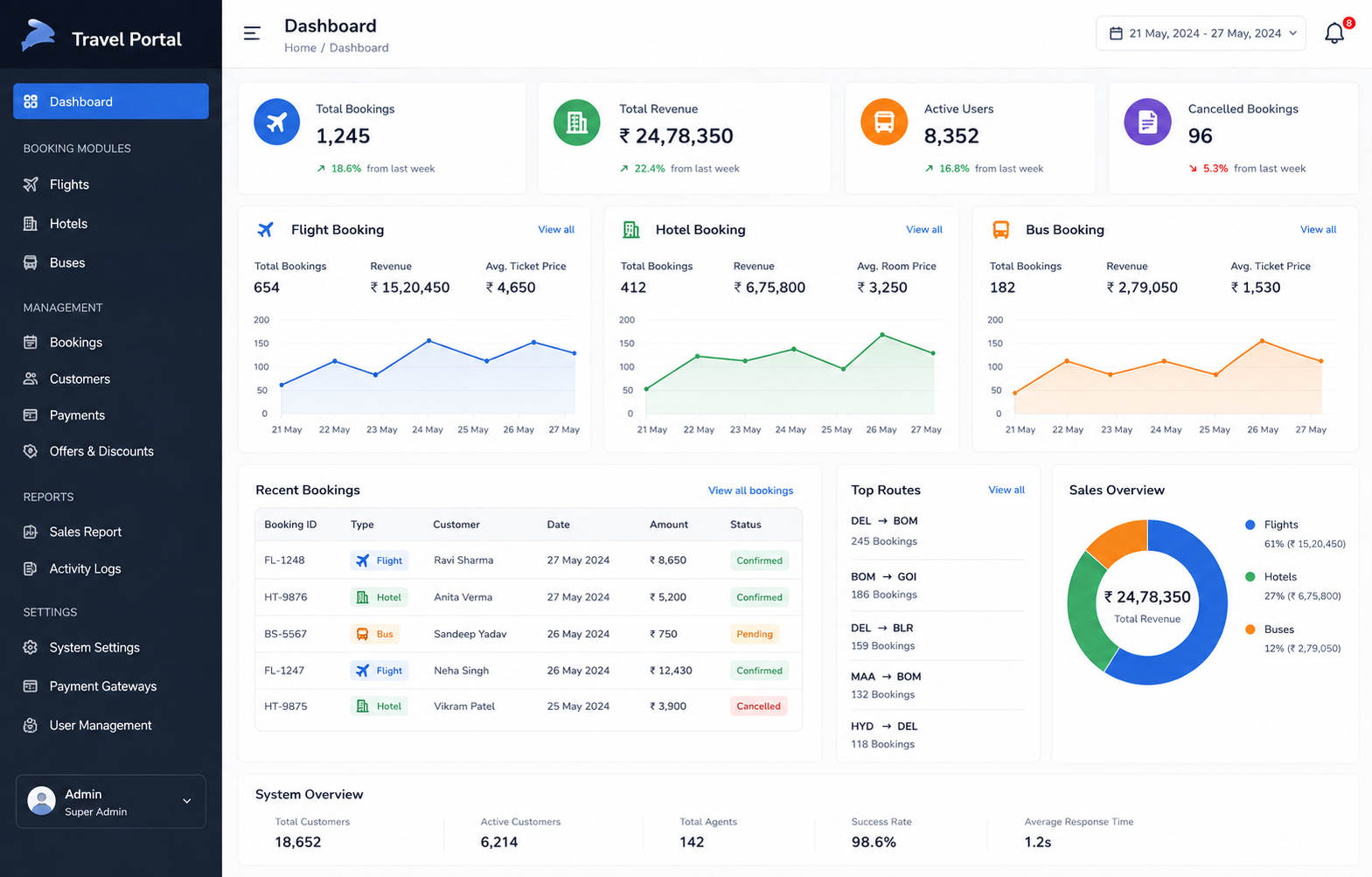
Rayds develops travel portals with flight, hotel, bus, holiday, car and cruise booking capabilities, supplier API integrations, agent management, payment gateways and centralized administration.
Quick Navigation
Travel Portal Development Company for Modern Travel Businesses
Rayds is a travel portal development company providing solutions for travel agencies, tour operators, DMCs, travel consolidators, corporate travel companies and other businesses that need an online platform to sell and manage travel services.
A travel portal can bring search, availability, pricing, booking, payment, customer management and back-office operations into one platform. Depending on the business model, the solution can be designed for B2B agents, B2C customers, B2B2C distribution networks or corporate travel operations.
A development project can include booking engines, supplier integrations, agent management, commissions and markups, wallets and credit controls, payment gateways, booking management, reporting and responsive customer-facing interfaces.
Travel Portal Development Services
Travel portal development can combine multiple booking products, business modules and integrations into a single platform. The required modules depend on the products a business sells and the way it distributes travel inventory.
Flight Booking Portal
Flight search, availability, fare display, passenger details, booking, ticketing and post-booking workflows through approved airline, GDS or flight supplier integrations.
Hotel Booking Portal
Hotel search, property information, room availability, rate display, room selection, booking, voucher generation and cancellation workflows.
Bus Booking Portal
Bus search, routes, seat selection, passenger information, payment processing and ticket confirmation workflows.
Holiday Package Portal
Package discovery, itinerary management, pricing, booking enquiries and online sales for tours and holiday products.
Car Booking Portal
Vehicle search, availability, rental details, pricing, booking and supplier management for car rental and transfer services.
Cruise Booking Portal
Cruise inventory, itinerary information, cabin selection, pricing and booking workflows where supplier connectivity is available.
Core Modules of a Travel Portal
A complete travel portal usually consists of multiple connected modules. Each module handles a different part of the booking and business-management process.
Customer Booking Portal
A responsive customer interface for searching travel products, comparing options, completing bookings and accessing booking information.
B2B Agent Portal
Agent registration, login, travel search, booking, markup, commission, wallet, credit and account-management functionality.
Admin Panel
Centralized control for users, agents, suppliers, bookings, payments, commissions, configuration and operational reporting.
Supplier & API Layer
Connectivity between the booking platform and approved travel inventory, payment, notification and other third-party services.
Custom Travel Portal Development
Custom travel portal development is suitable for businesses that need workflows, pricing rules, integrations or user roles that are not fully covered by a standard platform. Rayds can structure the portal around the business model, travel inventory and operational requirements defined during discovery.
Custom UI/UX
Design customer, agent and administration interfaces around the required booking journeys and brand experience.
Business Rules
Configure markups, commissions, agent levels, credit or wallet rules and booking workflows according to the project scope.
Supplier & API Integrations
Connect approved travel inventory, payment and other third-party services required for the platform.
Admin & Reporting
Manage users, bookings, suppliers, pricing, payments, commissions and operational reports from a centralized administration layer.
B2B Travel Portal Development for Travel Agents
A B2B travel portal is designed for businesses that distribute travel inventory to agents, sub-agents or other travel partners. The platform requires business rules that are different from a direct-to-consumer booking website.
Agent Management
Manage agent registration, profiles, access levels, bookings and account activity.
Agent Hierarchy
Support parent agents, sub-agents and role-based access where multiple distribution levels are required.
Markup & Commission
Configure business rules for markups, commissions and agent-specific pricing.
Wallet & Credit Management
Manage prepaid balances, credit limits, ledger activity and booking deductions.
B2B Booking Engine
Give agents access to travel inventory, search, booking, cancellation and post-booking workflows.
Reports & Ledger
Provide sales, booking, payment, wallet, commission and outstanding-balance reports.
B2C Travel Portal Development for Online Bookings
A B2C travel portal allows travelers to search and book travel products directly through a branded website or application. The interface should make the search, comparison, checkout and confirmation journey simple across desktop and mobile devices.
- Customer registration and login
- Flight, hotel, bus and other travel searches
- Filters, sorting and fare or room comparisons
- Secure payment gateway integration
- Booking history and customer accounts
- Cancellation and modification workflows
- E-ticket, voucher and booking confirmation generation
- Coupon and promotional functionality where required
- Email, SMS or WhatsApp notifications where supported
- Responsive and mobile-first booking experience
B2B2C Travel Portal Development
A B2B2C travel portal connects a supplier, wholesaler or travel technology company with agents or resellers who then sell travel products to end customers. This model can combine centralized inventory with multiple branded distribution channels.
Depending on the project, the platform can include agent onboarding, reseller access, branded storefronts, centralized inventory, pricing rules, commissions, wallets, reporting and customer-facing booking journeys.
Key Features of a Modern Travel Portal
- Real-time availability and pricing
- Flight and hotel booking workflows
- B2B agent management
- Multi-level agent hierarchy
- Markup and commission management
- Wallet and credit management
- Payment gateway integration
- Booking modification and cancellation
- E-ticket and voucher generation
- Customer and booking management
- Reports and analytics
- Responsive, mobile-first interface
Travel API Integration for Booking Platforms
Travel portals often depend on external inventory providers. API integrations allow the platform to retrieve availability and pricing, display travel products and send booking requests to connected suppliers.
Depending on the project and supplier agreements, integrations can include flight, hotel, bus, car rental, holiday and other travel inventory sources, along with payment and notification services.
Flight API Integrations
Connect approved airline, GDS and flight supplier sources for search, fare, booking and post-booking workflows.
Hotel Supplier APIs
Connect hotel inventory providers for property search, room availability, pricing and reservations.
Payment Gateway APIs
Integrate payment providers required by the business and its target market.
Other Supplier APIs
Integrate bus, car, holiday, cruise or other supplier systems according to availability and commercial agreements.
How a Travel Portal Works
A travel booking platform typically connects the customer or agent interface with a booking engine, supplier systems, payment services and an administration layer.
The exact architecture depends on the supplier ecosystem, business model, expected traffic, booking volume, user roles and required integrations. A custom architecture can be designed when standard platform capabilities are not sufficient.
Technology for Travel Booking Platforms
The technology stack should be selected according to the application's requirements rather than using one fixed stack for every travel business. A travel portal must handle booking workflows, external APIs, user roles, payments, business rules and operational data.
- Responsive web application and mobile-first interface
- Backend booking and business-rule layer
- Database for customers, agents, bookings, payments and configuration
- REST, XML and other API integrations with approved suppliers
- Payment gateway integration
- Authentication and role-based access controls
- Supplier response handling and booking-status synchronization
- Logging, monitoring and error handling
- Database optimization and backup procedures
- Security controls and SSL configuration
- Cloud or dedicated hosting according to project requirements
Our Travel Portal Development Process
1. Requirements & Business Analysis
Define the business model, travel products, user roles, supplier sources, booking flow, payment process and reporting requirements.
2. UI/UX & Architecture
Plan the customer or agent journey, administration structure, database requirements and integration architecture.
3. Development & Integrations
Develop the booking engine, user management, business rules, administration modules and required supplier or payment integrations.
4. Testing & Quality Assurance
Test search, pricing, booking, payment, cancellation, user permissions and supplier responses before launch.
5. Deployment & Training
Configure the production environment, domain, SSL and required integrations, then train the team on operational workflows.
6. Post-Launch Support
Continue monitoring, maintenance, bug fixes, security updates and agreed feature enhancements after launch.
Travel Portal Development Cost
The cost of travel portal development depends on the number of booking modules, supplier integrations, business rules, user roles, custom UI/UX, mobile applications, payment requirements and level of customization.
Instead of using one fixed price for every project, the scope should be defined first and then priced according to the required modules, integrations and development requirements.
| Solution Type | Typical Scope | Cost Consideration |
|---|---|---|
| White Label | Pre-built platform, branding and configuration | Lower initial development effort |
| Custom Travel Portal | Custom booking workflows, business rules and integrations | Depends on scope and integrations |
| B2B Travel Portal | Agents, hierarchy, commissions, wallet and reporting | Depends on agent and business-rule complexity |
| Enterprise Platform | Multiple services, channels, integrations and advanced controls | Requires detailed technical discovery |
For more information, visit our travel portal cost and pricing page .
Custom Travel Portal vs White Label Travel Portal
Both approaches can be appropriate depending on the business requirements. The main difference is whether the business needs a platform built around its specific requirements or wants to launch using an existing platform.
| Requirement | Custom Development | White Label |
|---|---|---|
| Launch speed | Longer development cycle | Faster setup |
| Customization | High flexibility | Depends on available platform modules |
| Integrations | Designed around project requirements | Uses supported integrations |
| Ownership | Can be structured for code ownership | Usually based on platform licensing or agreement |
| Typical use case | Specialized or complex requirements | Faster market entry |
If your priority is a branded platform that can be launched quickly, explore the Rayds White Label Travel Portal .
Who Needs Travel Portal Development?
Travel portal technology can be used by businesses that need to sell, distribute or manage travel inventory through digital booking channels.
Travel Agencies
Manage direct bookings or give agents access to travel inventory, pricing and booking tools.
Tour Operators
Sell holiday packages, hotels, transfers and other destination services through an online platform.
DMCs
Distribute destination inventory and services to travel partners and agents.
Travel Consolidators
Distribute travel inventory through B2B networks and manage agent commercial rules.
Corporate Travel Companies
Manage corporate travel bookings, user access, approval workflows and reporting where required.
Hotels & Resorts
Develop direct booking channels and connect accommodation inventory to online customers or partners.
Why Choose Rayds for Travel Portal Development
Rayds focuses on travel technology and booking-platform development for businesses that need B2B, B2C or B2B2C capabilities.
Travel-Focused Development
Solutions are designed around travel booking, distribution, agent and supplier workflows.
B2B, B2C & B2B2C
Build customer-facing, agent-facing or multi-channel travel platforms according to the business model.
API Connectivity
Integrate approved travel suppliers, payment services and other third-party systems required by the project.
Scalable Business Modules
Add booking, agent, commission, wallet, reporting and administration capabilities as required.
Build Your Travel Portal With Rayds
Tell us what you want to sell, which suppliers you need to connect and whether your business is B2B, B2C or B2B2C. Our team can help define the required modules, integrations, development approach and project scope.
Frequently Asked Questions About Travel Portal Development
What is travel portal development?
Travel portal development is the process of building an online platform for searching, booking and managing travel products such as flights, hotels, buses, holidays, cars or cruises. It can include booking engines, supplier integrations, payment gateways, customer management and administration tools.
How much does travel portal development cost?
The cost depends on the booking modules, supplier and API integrations, user roles, business rules, design requirements, payment systems and other custom functionality. A detailed scope is required for an accurate project estimate.
How long does it take to develop a travel portal?
The timeline depends on the project scope. A white-label setup can be configured faster than a custom platform, while a custom travel portal with multiple integrations and business workflows requires a longer development and testing cycle.
Can you develop both B2B and B2C travel portals?
Yes. A project can be designed for B2B agents, B2C customers or a combined B2B2C model. Features such as agent hierarchy, commissions, wallets and customer booking workflows can be included according to requirements.
Can a travel portal integrate with travel APIs?
Yes. Travel portals can connect with airline, hotel, bus, car, holiday and other supplier APIs where access and commercial agreements are available.
What features should a B2B travel portal include?
Common B2B requirements include agent registration, role-based access, agent hierarchy, booking access, markup and commission rules, wallet or credit management, booking history, cancellation workflows and financial reporting.
Can I start with a white-label travel portal and move to custom development later?
This can be possible depending on the platform, data structure and commercial agreement. Businesses should confirm data portability, API access, source-code ownership and migration terms before selecting a platform.
Do you provide post-launch travel portal support?
Post-launch support can include maintenance, bug fixing, monitoring, security updates and agreed enhancements. The exact support scope and response terms should be defined in the project or support agreement.