GST on Travel Services in India: Air Tickets, Hotels and Tour Packages
Written by the Rayds team · Updated
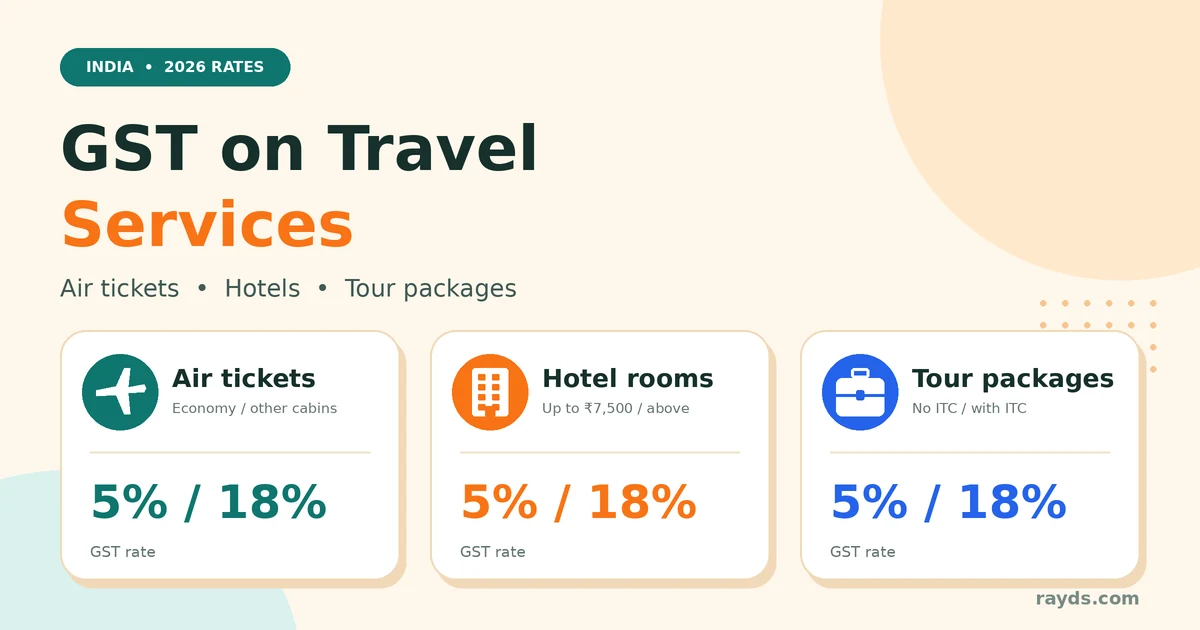
A single trip can bundle a flight, a hotel and a tour, and each part is taxed differently under GST. For a travel agent, that means getting the rate, the input tax credit (ITC) treatment and the invoice right on every booking.
We build booking and B2B portal technology at Rayds, so this guide is written for agents and travel businesses. It covers the current rates for air tickets, hotels and tour packages, what travel agents charge on their own fees, how TCS on overseas tours works, and how to keep invoices clean.
The short answer
Economy air tickets carry 5% GST and other cabins 18%. Hotel rooms up to ₹7,500 per night carry 5% without ITC, and rooms above that carry 18%. Tour packages are taxed at 5% without ITC or 18% with ITC, at the operator's option. Agent commissions and service fees are generally 18%. Overseas tour packages also attract 2% TCS, which is not GST.
Please note: this is general information based on rates in force as of October 2026, not tax advice. Rates and conditions can change, so confirm your specific case with a chartered accountant or the latest CBIC notifications.
GST Rates on Travel Services at a Glance
| Service | GST rate | ITC for the supplier | SAC code |
|---|---|---|---|
| Air ticket, economy class | 5% | Limited (input services only) | 996425 |
| Air ticket, premium economy, business, first | 18% | Full | 996425 |
| Hotel room up to ₹1,000 per night | Exempt | Not applicable | 9963 |
| Hotel room ₹1,001 to ₹7,500 per night | 5% (mandatory) | No | 9963 |
| Hotel room above ₹7,500 per night | 18% | Yes | 9963 |
| Tour package (operator as principal) | 5% without ITC, or 18% with ITC | As per option chosen | 998552 / 998555 |
| Air ticket booking service by agent | 18% | Yes | 998551 |
| Visa, passport and similar service charges | 18% | Yes | 998555 |
Rates for air tickets and hotels changed on 22 September 2025 following the 56th GST Council meeting. SAC codes shown are the ones commonly used; always confirm the code with your accountant.
GST on Air Tickets
GST on passenger air travel depends on the class of travel:
- Economy class: 5% GST.
- Premium economy, business and first class: 18% GST. This was 12% until 21 September 2025.
The rate follows the cabin class, not the airline. A full-service carrier and a low-cost carrier both charge 5% on economy fares. The rate applies on the taxable fare, and airline-levied charges can be taxed differently, so check the breakup on the airline's invoice.
Example
| Cabin | Base fare | GST | Total |
|---|---|---|---|
| Economy | ₹6,000 | 5% = ₹300 | ₹6,300 |
| Business | ₹15,000 | 18% = ₹2,700 | ₹17,700 |
International flights: published guidance states that flights departing from India are taxed at 5% for economy and 18% for the other classes, whether the destination is domestic or international. Rules for tickets issued for journeys starting abroad differ, so check these separately.
For business customers: a GST-registered company can generally claim input tax credit on tickets bought for genuine business travel, as long as its GSTIN is on the invoice. Make sure your booking flow captures the GSTIN before ticketing, because it is hard to add afterwards.
GST on Hotel Rooms
Hotel GST depends on the room tariff per unit per day, not on the hotel's star rating. The government's FAQs on the 56th GST Council decisions confirm that accommodation valued at ₹7,500 or less per unit per day attracts 5% without ITC, and that hotels cannot opt for 18% with ITC on those rooms.
| Room tariff per night | GST rate | Example |
|---|---|---|
| Up to ₹1,000 | Exempt | ₹900 room: no GST |
| ₹1,001 to ₹7,500 | 5% | ₹5,000 room + ₹250 GST = ₹5,250 |
| Above ₹7,500 | 18% | ₹9,000 room + ₹1,620 GST = ₹10,620 |
Dynamic pricing matters. The slab depends on the tariff charged for that night, so the same room can fall under 5% on a weekday and 18% on a peak weekend. Your booking system should apply the rate per night, not once per stay.
Place of supply: for hotel bookings, the place of supply is the hotel's location, so the state tax split (CGST and SGST, or IGST) follows the hotel's state.
GST on Tour Packages
A tour operator who sells a bundled package (hotel, transport, sightseeing and so on) as the principal can choose between two options:
- 5% GST without ITC on the gross package value. The operator cannot claim credit on hotels, flights or cabs bought as inputs. The only credit allowed is on input services bought from another tour operator.
- 18% GST with ITC. The operator charges 18% on the package and claims credit on eligible input taxes, such as rent, professional services and telecom.
Most operators selling packages directly to consumers choose 5%, because it keeps the customer's price lower. Operators selling mainly to GST-registered businesses, or with large eligible input costs, may find 18% with ITC works better. Run the numbers with your accountant before choosing.
Inbound tours: services supplied by an Indian tour operator to a foreign tourist for a tour conducted wholly outside India are not taxed under the same rules; this is a niche case, so check it with your accountant. Inbound tour services within India are generally taxed at 18% with ITC.
Example: 5% package
A 4-night package sold to a customer at ₹1,00,000 (before GST) under the 5% scheme carries ₹5,000 GST, for a total of ₹1,05,000. If the package is overseas, TCS is collected separately (see below).
GST on Travel Agent Commission and Service Fees
The earlier rates apply when you sell a service as the principal. When you act as an agent, you are taxed on what you earn:
- Commission from airlines, hotels and other suppliers: 18% GST, with ITC available on your business inputs.
- Air ticket booking service charges: 18% (SAC 998551).
- Visa, passport and similar service fees: 18% (SAC 998555).
- Rail and bus booking commission: generally 18% on the commission or service charge.
The customer pays GST on the ticket or room at the supplier's rate, and you separately charge 18% on your own fee. Show these as separate lines so your invoice is clear. This also affects how you set your margins; our guide to travel agent markup pricing explains how to build tax into your price.
TCS on Overseas Tour Packages
TCS (tax collected at source) is an income tax collection and is separate from GST. Until 31 March 2026, TCS on overseas tour packages was 5% up to ₹10 lakh and 20% above it. The Union Budget 2026-27 changed this:
- From 1 April 2026, TCS on the sale of an overseas tour programme package is a flat 2%, with no amount threshold.
- Show TCS as a separate line on the invoice, outside the GST total.
- The customer can adjust the TCS against their income tax liability when filing their return.
The income tax rules were also re-numbered under the Income Tax Act, 2025, which took effect on 1 April 2026, so check section references with your accountant.
Input Tax Credit for Travel
ITC is where many travel agencies lose money or get into trouble.
- You charge 5% on packages or hotel rooms: no ITC on those supplies (apart from the narrow exception for input tour operator services).
- You charge 18%: you can claim ITC on eligible business costs.
- Your corporate customers: they can usually claim ITC on air tickets and hotel rooms booked for business purposes, if their GSTIN is on a valid tax invoice.
- Blocked credits: GST law restricts ITC on some personal or non-business travel benefits, so keep business-purpose records.
Invoicing Tips for Travel Agents
- Collect the customer's GSTIN at booking for business clients, and validate it.
- Use the right SAC code per line: package, booking fee and visa fee are different services.
- Separate supplier charges from your fee. Show the airline fare, hotel tariff and your service charge on separate lines with their own GST rates.
- State the tax option on package invoices. For example: "GST charged at 5% under the tour operator scheme; no ITC claimed."
- Show TCS separately on overseas packages.
- Apply the right place of supply so IGST or CGST and SGST are correct.
- Automate rate rules. A booking platform should pick the rate by cabin class, nightly tariff and product type, and generate GST-ready invoices.
Common GST Mistakes in Travel
- Charging a flat rate on every hotel night instead of checking the tariff slab.
- Applying the economy rate to premium economy or business fares.
- Claiming ITC while also charging the 5% no-ITC rate on packages.
- Combining your service fee with the supplier's price, which hides the 18% on your fee.
- Leaving out TCS on overseas packages, or including it inside the GST total.
- Missing the customer's GSTIN, so a business client cannot claim credit.
- Relying on rates from articles written before the 22 September 2025 changes.
Frequently Asked Questions
Sources
Rates are as reported in October 2026 and may be revised. This page is for general information only.
- PIB: FAQs on the decisions of the 56th GST Council
- PIB: FAQs-2 on the decisions of the 56th GST Council (hotel accommodation up to ₹7,500)
- GST Council: Recommendations of the 56th meeting
- TAXAJ: GST on travel, travel agents and tour operators (air travel and tour operator options)
- IANS via Morung Express: Budget 2026-27 TCS announcement (overseas tour packages at 2%)
- Patron Accounting: TCS rate changes from April 2026
Need GST-Ready Invoicing on Your Travel Portal?
We can show you how rate rules by cabin class, room tariff and product type, GSTIN capture and separate fee lines work on a white label B2B travel portal.
Talk to Our Team