10 Proven Strategies to Increase Travel Bookings Online
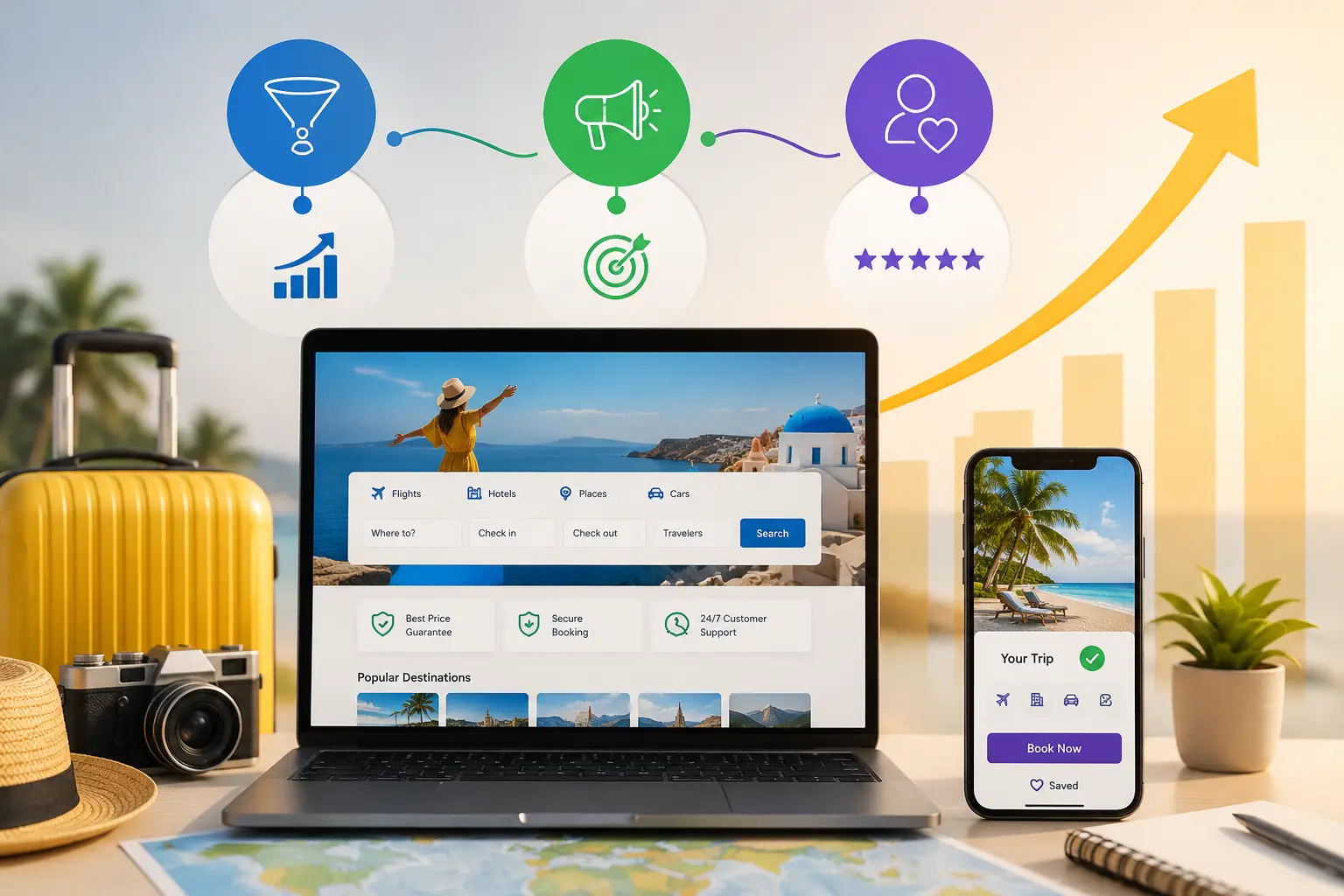
The travel industry is increasingly moving online. Customers no longer wait in an agent's office to book a trip — they browse, compare, and book on their own time, from their devices. For travel agencies, this shift creates a challenge: how do you increase online bookings when your customers have endless options?
The answer isn't about doing more marketing. It's about converting more of the traffic you already have. In this comprehensive guide, we share 10 proven strategies that travel agencies across India are using to increase bookings, reduce cart abandonment, and build loyal customer bases. These strategies are tested, quantified, and can be implemented immediately on your travel booking portal.
Why Most Travel Agencies Fail to Convert Website Visitors
Before we dive into solutions, let's understand the problem. Travel agencies typically see 100+ visitors per day on their website but convert fewer than 2% into bookings. Where do the other 98% go?
The reasons are predictable:
- Slow booking process: 5+ clicks to see a price, confusing checkout
- No trust signals: No reviews, testimonials, or social proof visible
- Generic recommendations: Every visitor sees the same 10 packages
- Hidden costs: Price shown doesn't match final amount (taxes, fees surprise)
- No urgency: Customers bookmark and leave, forgetting to return
- Poor mobile experience: Website is hard to navigate on phones
- Abandoned carts: 70% of carts are abandoned; no follow-up happens
The good news? Each of these is fixable. And when you fix them together, your conversion rate skyrockets.
10 Proven Strategies to Increase Travel Bookings Online
1. Simplify Your Booking Flow (Reduce Friction)
A complicated booking process is the #1 killer of travel sales. Every extra click, form field, or page increases the chance a customer abandons the process.
Optimize your booking flow:
- One-page checkout: Show price, customer details, and payment on one page (or at most 2 pages)
- Progress indicator: Show customers how many steps remain
- Pre-fill data: Use browser data and cookies to auto-fill known information
- Guest checkout: Allow customers to book without creating an account
- Multiple payment options: Credit cards, debit cards, UPI, wallets, EMI
- Clear pricing: Show all-inclusive price upfront; no surprise fees
Impact: Travel agencies reducing checkout steps from 5+ to 2-3 see 20-30% improvements in conversion rates. Airbnb reduced their booking process to just 3 taps on mobile — and conversion skyrocketed.
2. Build Trust with Reviews, Testimonials, and Social Proof
A new visitor to your website doesn't know if you're trustworthy. Why should they book with you instead of Expedia or MakeMyTrip? Social proof answers this question instantly.
Display social proof throughout your website:
- Customer reviews: Show real customer reviews with names, photos, and ratings
- Star ratings: Display your overall rating (4.5/5 stars, etc.) prominently
- Testimonial videos: Video testimonials from customers talking about their trip convert 2-3x better than text
- Trust badges: Show certifications (IATA, ISO, Google Partner, etc.)
- Recent bookings: Display who booked what recently ("Priya from Delhi booked Bali in the last 2 hours")
- Customer count: "35,000+ happy travelers" or "10,000+ bookings this month"
Impact: Websites with visible customer reviews and testimonials see 30-50% higher conversion rates. Video testimonials increase conversions by 80%.
3. Implement Personalized Package Recommendations
Generic "Featured Packages" sections don't work. Customers want recommendations tailored to them. Personalization is now the #1 factor driving online bookings.
Personalize recommendations based on:
- Browsing history: "Customers who viewed Bali also loved Thailand"
- Search queries: If they searched "beach + kids," show family-friendly beach resorts
- Budget: Show packages within their stated or inferred budget
- Travel dates: Recommend destinations that are best during their preferred season
- Past bookings: "You loved Goa last year, try Kerala this year"
- Time of day: Show different packages to morning vs. evening visitors
Impact: Personalized recommendations increase click-through rates by 25-35% and conversion rates by 15-25%. AI-powered personalization engines make this automatic.
4. Use Targeted Email Marketing to Re-Engage Abandoners
70% of shopping carts are abandoned in e-commerce. Travel is even worse — abandonment rates hit 80-85%. But here's the secret: a strategic email sequence can recover 30-40% of abandoned carts.
Build an abandoned cart recovery sequence:
- Email 1 (1 hour later): Remind them of the package, show the price again, 1-click return link
- Email 2 (24 hours later): Highlight benefits and customer reviews of that destination
- Email 3 (3 days later): Add urgency ("Only 2 rooms left at this price")
- Email 4 (7 days later): Last chance offer with a small discount (5-10%)
Beyond abandonment recovery, segment your email list:
- Past bookers: Recommend new destinations; offer loyalty discounts
- Website visitors (no booking): Educational content about destinations; limited-time offers
- Newsletter subscribers: Weekly deals, travel tips, customer stories
Impact: A well-executed email marketing strategy recovers 25-40% of abandoned bookings and generates 30-50% of your repeat bookings. Email ROI is 36:1 (highest of any marketing channel).
5. Optimize for Mobile-First Browsing
70% of travel bookings now originate on mobile devices. If your website isn't mobile-optimized, you're losing customers immediately.
Ensure mobile optimization:
- Responsive design: Website automatically adjusts to screen size
- Fast loading: Mobile pages load in under 3 seconds
- Simplified navigation: Minimal tabs, large buttons, touch-friendly
- Streamlined search: Search bar is prominent and autocomplete works
- Mobile checkout: Checkout process works seamlessly on phones (no manual typing long addresses)
- Click-to-call: Phone number is clickable; customers can call you immediately
Impact: Mobile-optimized travel websites see 2-3x higher conversion rates from mobile traffic. Google now ranks mobile-first websites higher in search results.
6. Create Urgency and Scarcity
Humans respond to scarcity and urgency. When customers feel like a deal might disappear, they're more likely to book immediately instead of "thinking about it."
Create urgency and scarcity:
- Limited-time offers: "This discount expires in 48 hours"
- Inventory scarcity: "Only 3 rooms left at this hotel" or "2 spots remaining on this tour"
- Price locks: "Lock this price now; prices increase next week"
- Countdown timers: Visual timer showing when an offer expires
- Flash sales: "Weekend Sale: 20% off beach packages today only"
- Early-bird discounts: "Book 60 days early and save 15%"
Caution: Use urgency honestly. False claims ("Only 1 room left" when you have 20) damage trust. But real scarcity and real time limits are powerful conversion drivers.
Impact: Urgency messaging increases conversions by 15-25%. Flash sales drive 2-3x more bookings than regular offers.
7. Invest in SEO to Drive Qualified Traffic
Paid ads are expensive and have high customer acquisition costs. Organic search is the opposite: free, ongoing traffic from customers actively looking for travel packages.
Improve your SEO:
- Keyword research: Target keywords like "budget Bali tour packages," "best honeymoon destinations in India," "weekend trip near Delhi"
- Content strategy: Create destination guides, travel tips, and blog posts (like this one) that rank in Google
- Local SEO: Get listed in Google My Business; ask for reviews
- Technical SEO: Fast website, mobile optimization, clean URL structure
- Backlinks: Guest posts, partnerships, mentions in travel blogs
Impact: Top-ranking websites for travel keywords get 30-50% of their traffic from organic search. Unlike ads, this traffic is "free" after your initial investment and continues indefinitely.
8. Use Chatbots for Instant Customer Support
When a customer has a question about a package or the booking process, they expect an answer immediately. If you're not available, they move to your competitor.
Implement AI chatbots to:
- Answer FAQs instantly: Visa requirements, best season to visit, activities available
- Provide recommendations: "What's a good 3-day trip under ₹30,000 for a couple?"
- Assist with bookings: "What happens if I need to cancel?" "Can I get travel insurance?"
- Track orders: "Where's my booking confirmation?" "When do I receive tickets?"
- Collect information: "When do you want to travel?" "What's your budget?" (qualification)
Impact: Websites with chatbots see 10-30% improvement in conversion rates. Chatbot users have higher average order value (they get better recommendations). Response time improvements reduce cart abandonment.
9. Offer Flexible Payment Options and Financing
A ₹50,000 trip feels expensive for many customers. When you offer payment flexibility, you remove a major barrier to booking.
Provide payment flexibility:
- EMI options: "Pay ₹50,000 in 3 EMIs of ₹16,667" (interest-free or with interest)
- Partial payment: 30% upfront at booking, rest 30 days before travel
- Multiple payment methods: Credit card, debit card, net banking, UPI, digital wallets, bank transfers
- Buy now, pay later (BNPL): "Pay in 3 installments with no interest"
- Gift cards: Customers can gift travel packages (new booking source)
Impact: Offering EMI options increases average booking value by 20-30% and attracts price-sensitive customers who would otherwise not book. EMI+Credit card customers are more likely to book higher-value packages.
10. Build Community and Encourage Repeat Bookings
Acquiring a new customer costs 5-25x more than retaining an existing one. Your best source of future bookings is your past customers.
Build customer loyalty:
- Loyalty program: Points for every booking; redeem for discounts or free trips
- Referral rewards: "Refer a friend, both get ₹2,000 discount"
- VIP tier: Regular bookers get 10% discount on all packages
- Birthday offers: Special discount during customer's birthday month
- Re-engagement campaigns: "It's been 6 months since your last trip. Here's 15% off your next booking"
- Community: Private Facebook group for customers to share trip photos and tips
Impact: Repeat customers have 40-50% higher booking frequency than first-time customers. A well-designed loyalty program increases customer lifetime value by 25-40%.
Quick Comparison: Traditional vs. Optimized Approach
| Element | Traditional Agency Website | Optimized Website | Improvement |
|---|---|---|---|
| Conversion Rate | 0.5-1% | 2-3% | 3-6x higher |
| Booking Flow Steps | 5-8 steps | 2-3 steps | 60-75% reduction |
| Customer Support | Email/phone (response time: 4-24 hours) | Chatbot (instant) + agent escalation | Response time: minutes instead of hours |
| Cart Abandonment Recovery | 0% (no follow-up) | 25-40% (email sequences) | 25-40% revenue recovery |
| Mobile Optimization | Poor (desktop-focused) | Mobile-first design | 2-3x mobile conversion rate |
| Personalization | Generic recommendations for all | AI-powered personalized to each visitor | 20-30% higher engagement |
| Customer Lifetime Value | ₹25,000 (1-2 bookings) | ₹60,000+ (4-5 bookings) | 2-3x higher CLV |
Real-World Examples: Travel Agencies Succeeding Online
Here's how travel agencies across India are using these strategies to increase bookings:
- Azure Travels (Pune): Simplified checkout to 2 steps (instead of 6) and added reviews carousel. Conversion rate increased from 0.8% to 2.4% in 60 days. Monthly bookings grew from 50 to 150.
- Wanderlust Vacations (Bangalore): Implemented abandoned cart email sequence. Recovered 35% of abandoned carts. This alone generated ₹5 lakhs in additional monthly revenue with zero new traffic.
- Paradise Tours (Delhi): Launched loyalty program (points for every booking). Repeat booking rate increased from 15% to 35%. Customer lifetime value nearly doubled in 6 months.
- Beach Getaways Co. (Goa): Added AI chatbot to handle booking inquiries. Support team productivity increased 40%. Customers who interacted with chatbot had 25% higher booking completion rate than those who didn't.
- Mountain Escapes (Himachal): Launched SEO strategy targeting local keywords ("best honeymoon packages near Manali," "budget hill station tours"). Organic traffic grew from 200/month to 2,000/month in 6 months. Organic now contributes 40% of bookings.
How to Implement These Strategies
You don't need to implement all 10 strategies at once. Start with the top 3-4 that match your current challenges:
- If conversion is low: Focus on strategies #1, #2, #3, #5 (simplify checkout, add social proof, personalize, mobile optimize)
- If you have traffic but low conversions: Focus on #1, #2, #6, #8 (reduce friction, build trust, create urgency, add chatbot)
- If you want to grow bookings: Focus on #4, #7, #10 (email marketing, SEO, loyalty program)
- If you need immediate revenue: Focus on #4, #6, #9 (recover abandoned carts, create urgency, offer financing)
The best part? Modern white label travel portals come with most of these features built-in. Platforms like Rayds include mobile optimization, personalization, chatbots, email marketing, and analytics — all pre-configured and ready to launch.
Tools and Technologies to Enable These Strategies
Here are the tools and platforms travel agencies use to implement these strategies:
- White Label Travel Portal: Manages bookings, personalization, reviews, and analytics (e.g., Rayds)
- Email Marketing Platform: Abandoned cart recovery, segmentation, automation (Mailchimp, ConvertKit, etc.)
- AI Chatbot: 24/7 customer support, lead qualification, booking assistance (Intercom, Drift, etc.)
- SEO Tools: Keyword research, rank tracking, content optimization (Semrush, Ahrefs, Moz)
- Analytics Platform: Understand user behavior, conversion funnel, abandonment points (Google Analytics)
- Review Management: Collect, display, and manage customer reviews (Trustpilot, Google Reviews)
Measuring Success: Key Metrics to Track
To know if your strategies are working, track these key metrics:
- Conversion Rate: Bookings ÷ Website Visitors. Target: Improve from your current rate by 50-100% in 90 days.
- Average Order Value (AOV): Total booking value ÷ Number of bookings. EMI and upselling should increase this.
- Cart Abandonment Rate: Carts created minus completed bookings. Target: Keep below 70%; recover 25-40% via email.
- Customer Acquisition Cost (CAC): Total marketing spend ÷ New customers. Track by channel to see what works.
- Customer Lifetime Value (CLV): Average revenue per customer over their lifetime. Loyalty programs should increase this.
- Repeat Booking Rate: Customers who book 2+ times ÷ Total customers. Target: 30%+ for mature agencies.
Related Articles
- How AI Is Changing the Travel Industry in 2026 — Personalization, Chatbots & Automation
- White Label Travel Portal — Full Features and Pricing
- Best White Label Travel Portal Provider in India (2026) — Top 7 Compared
- Travel Agent Marketing Strategies — Digital, Email & Content Marketing
Frequently Asked Questions
Start Increasing Bookings Today
Launch a fully optimized travel portal with built-in personalization, chatbots, email marketing, and analytics — all working together to increase bookings.
Request DemoSee It in Action
Watch how agencies are using these strategies to convert more visitors into customers.
Watch Demo