How AI Is Changing the Travel Industry in 2026
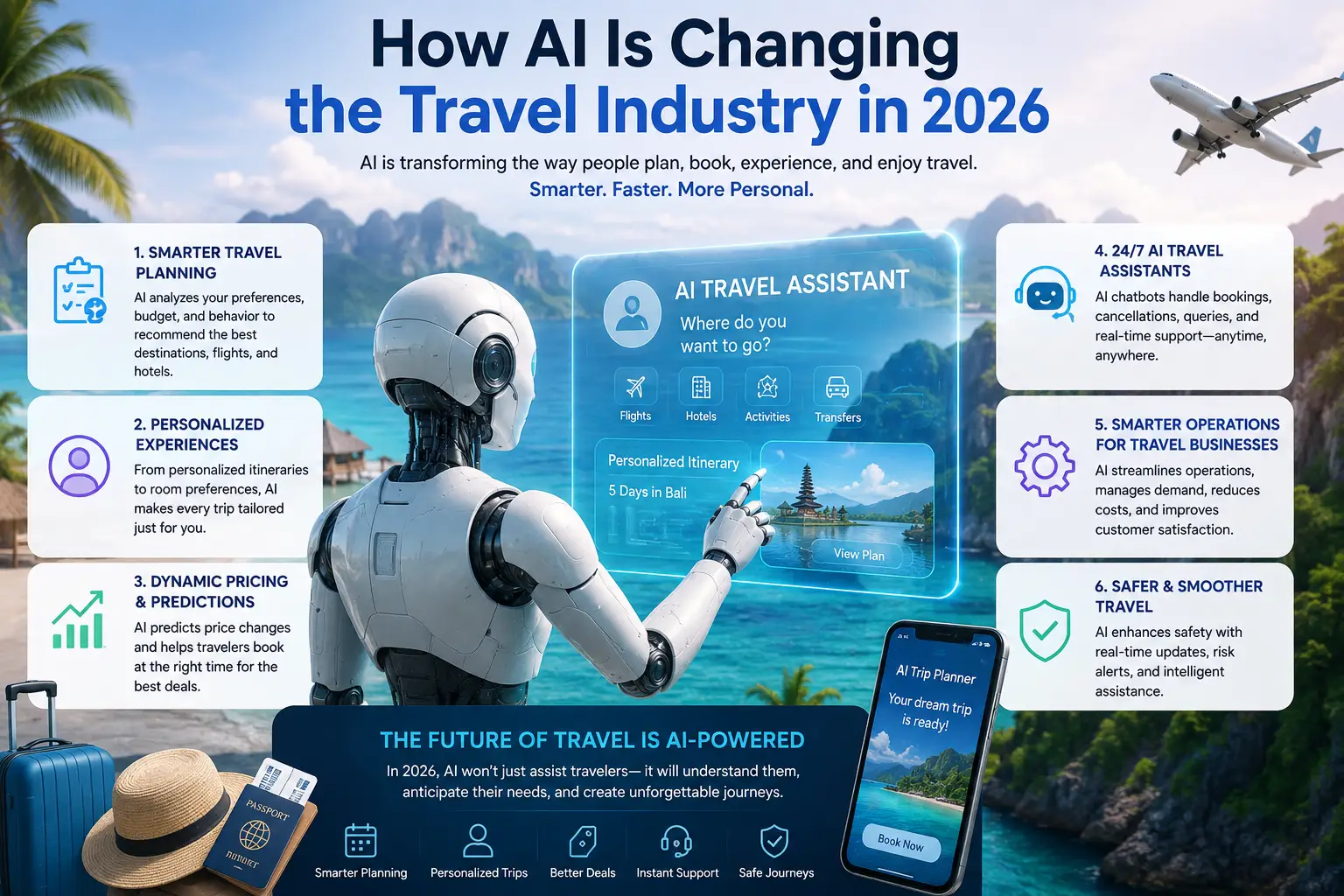
Artificial Intelligence (AI) is no longer a futuristic concept for the travel industry — it's reshaping how travel agencies operate, how customers book trips, and how entire businesses compete in the market. From personalized recommendation engines to automated customer service, AI is making travel planning faster, cheaper, and more enjoyable.
For travel agents in India, understanding and adopting AI-powered tools is essential to stay competitive. In this comprehensive guide, we explore how AI is transforming the travel industry, what opportunities it creates for travel agents, and how you can leverage AI inside your travel booking portal to increase bookings and customer loyalty.
What is AI in Travel and Why Does It Matter?
AI in travel refers to machine learning algorithms and intelligent automation systems that analyze customer behavior, predict preferences, and automate routine tasks. The travel industry generates massive amounts of data — flight prices, hotel availability, user browsing patterns, booking history — and AI transforms this raw data into actionable insights.
For travel agencies, AI means:
- Fewer manual tasks and less time spent on repetitive work
- Better customer experience through personalized recommendations
- Higher conversion rates by showing the right offer to the right customer at the right time
- Reduced operational costs through automation
- Competitive advantage in a market where customers expect fast, seamless service
The biggest travel portals globally — Booking.com, Expedia, MakeMyTrip — all use AI as a core competitive advantage. Travel agents who adopt AI-enabled portals can match these capabilities without the massive R&D investment.
Top 5 Ways AI Is Transforming Travel Agencies
1. Personalized Travel Recommendations
AI analyzes a customer's booking history, browsing behavior, budget, travel dates, and preferences to recommend highly personalized trip packages. Instead of showing every customer the same destinations, AI-powered portals show:
- Flights matching their preferred airlines and travel times
- Hotels matching their star rating and amenity preferences
- Destinations similar to ones they've visited or viewed in the past
- Budget-optimized packages based on their spending patterns
Impact for agents: When customers see recommendations tailored to them, they're more likely to book. Travel agents using AI-powered portals report 25-35% higher click-through rates on recommended packages.
2. AI-Powered Chatbots and 24/7 Customer Support
Customer questions about bookings, refunds, visa requirements, and itineraries used to require an agent to answer — even outside business hours. AI chatbots now handle routine queries instantly, 24/7, in multiple languages.
Modern AI chatbots can:
- Answer FAQs about flights, hotels, and destinations instantly
- Track booking status and provide updates in real-time
- Process refund requests and cancellations automatically
- Escalate complex issues to human agents seamlessly
- Provide recommendations based on conversation context
Impact for agents: Chatbots reduce the workload on your team by 40-50%, allowing your staff to focus on high-value tasks like building relationships and closing complex bookings. Customers get faster responses, improving satisfaction and repeat bookings.
3. Dynamic Pricing and Revenue Optimization
AI algorithms monitor thousands of price data points in real-time — competitor prices, demand patterns, seasonality, and inventory levels — to recommend the optimal price for your packages at any moment.
Travel agents benefit through:
- Automatic price adjustments based on demand (higher prices during peak season, lower during off-season)
- Smart bundling — AI suggests which flight + hotel combinations sell best together
- Discount optimization — AI determines when to offer discounts to maximize profit, not just volume
- Inventory forecasting — AI predicts which packages will sell out and which won't
Impact for agents: AI-driven pricing strategies can increase profit margins by 15-20% without sacrificing sales volume. Hotels and airlines are willing to offer better commission rates to agents who use data-driven selling.
4. Predictive Analytics and Booking Forecasting
AI doesn't just react to current trends — it predicts future behavior. Machine learning models analyze historical data to forecast:
- Which destinations will be trending in the next 3-6 months
- When customers are most likely to book (seasonal patterns, holidays, weekends)
- Which customer segments are most profitable
- The likelihood a customer will complete a booking (abandonment prediction)
Impact for agents: Instead of guessing which packages to promote, AI tells you exactly which marketing messages, offers, and packages will resonate with each customer segment. Your marketing ROI improves dramatically.
5. Automated Itinerary Planning and Trip Customization
AI can now generate complete, personalized itineraries based on customer input. A customer says "I have ₹50,000 and 5 days for a beach vacation with my family," and AI automatically:
- Suggests matching destinations, flights, and hotels within budget
- Creates day-by-day activity recommendations with timings
- Books restaurants, activities, and local experiences
- Provides travel tips, packing lists, and visa information
- Adjusts the entire itinerary if the customer changes preferences
Impact for agents: What used to take hours of manual work now takes minutes. Travel agents can quote and customize packages much faster, process more bookings, and delight customers with detailed, personalized itineraries.
AI Benefits for Travel Agents — The Bottom Line
| Area | Traditional Approach | AI-Powered Approach | Impact |
|---|---|---|---|
| Customer Support | Agent handles every query manually | Chatbot handles 70% of queries; agents handle complex issues | 40-50% time savings |
| Recommendations | Agent suggests based on intuition | AI suggests based on data and behaviour patterns | 30-40% higher conversion rates |
| Pricing | Fixed markup on all packages | Dynamic pricing optimized for demand and profit | 15-20% margin improvement |
| Lead Scoring | Follow up with every lead manually | AI identifies high-probability leads for prioritization | 2-3x faster deal closure |
| Itinerary Creation | Manually research and plan (hours) | AI generates and customizes in minutes | 5-10x faster turnaround |
Real-World Impact: How Travel Agents Are Using AI Today
Travel agencies across India are already leveraging AI to transform their businesses:
- Metro Travel (Bangalore): Using AI-powered recommendations increased repeat bookings from 20% to 45% in 6 months. Customers receive personalized package suggestions via email based on their past trips and browsing history.
- Wanderlust Tours (Delhi): Implemented AI chatbot for customer support, reducing response time from 4 hours to under 2 minutes. Customer satisfaction scores improved from 3.2 to 4.6 out of 5.
- Beach Holiday Specialists (Goa): Using AI pricing optimization, increased profit margins on package tours from 12% to 18% without raising prices — by better matching supply with demand.
- Adventure Getaways (Himachal): AI itinerary planning reduced quote generation time from 2 hours to 10 minutes per customer. Sales team productivity increased by 300%.
How to Add AI to Your Travel Portal
Travel agents don't need to build AI from scratch. Modern white label travel portals come with AI features already built-in:
- Personalization Engine: Automatically recommends packages to each visitor based on their behaviour and preferences
- Smart Search: AI understands natural language queries ("relaxing beach trip with kids under ₹1 lakh") and returns relevant results
- Dynamic Packaging: Customers can mix-and-match flights, hotels, and activities; AI optimizes the total price
- Chatbot & Virtual Assistant: Available 24/7 to answer queries and assist bookings
- Analytics Dashboard: AI-powered insights into customer behaviour, popular packages, conversion funnels, and revenue trends
- Lead Scoring: Automatically identifies which website visitors are most likely to book
If you're using Rayds travel portal, all these AI features are already integrated into your dashboard. You can activate them in minutes without any technical setup.
AI and the Future of Travel Agencies — What's Next?
AI in travel is evolving rapidly. Here's what's coming in the next 2-3 years:
- Voice-Activated Booking: "Alexa, book me a 5-day trip to Bali in July" — AI will understand complex voice commands and execute bookings
- AR/VR Integration: Customers will see virtual tours of hotels and destinations before booking, powered by AI
- Predictive Travel Insurance: AI will automatically recommend and adjust travel insurance based on destination risks, weather forecasts, and health trends
- Real-Time Itinerary Adjustment: AI will monitor flight delays, traffic, and weather during the trip and automatically adjust the customer's itinerary
- Hyper-Personalized Pricing: Every customer will see a price optimized just for them based on their budget, booking patterns, and willingness to pay
Travel agents who adopt AI now will be ahead of the curve. Those who wait risk losing market share to competitors who've already modernized their operations.
Related Articles
- Best White Label Travel Portal Provider in India (2026) — Top 7 Compared
- White Label Travel Portal — Full Features and Pricing
- 10 Proven Strategies to Increase Travel Bookings Online
- All Travel, Utility and Fintech Services by Rayds
Frequently Asked Questions
Unlock AI for Your Travel Business
Launch a fully branded travel portal powered by AI — with personalization, chatbots, dynamic pricing, and analytics — all ready in 2 hours.
Request AI DemoSee AI in Action
Watch how AI-powered recommendations and personalization increase bookings by 30-40%.
Explore FeaturesJoin AI-Powered Agencies
35,000+ travel agents are already using AI to grow their business with Rayds.
Become a Partner