How Does a B2B Travel Agency Actually Make Money? The Five Revenue Levers
Written by the Rayds team · Updated
A B2B travel agency can book crores of rupees in travel every month and still struggle to turn a profit. The reason is simple: most of every booking belongs to the airline, hotel or tour operator. What the agency keeps is a thin slice, and how it earns that slice decides whether the business grows or stalls.
Rayds is a white label travel portal provider for travel agencies, so we see how these businesses earn up close. This guide explains the five revenue levers a B2B travel agency can pull, which products suit each one, what eats into the profit, and how the numbers work in a realistic month.
The short answer
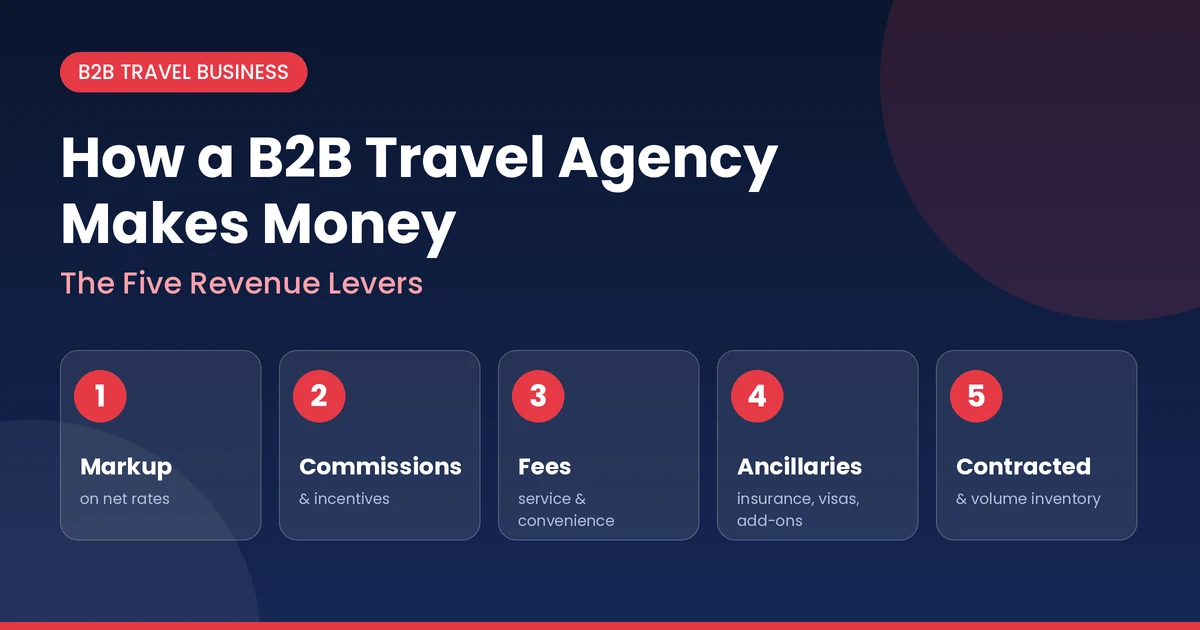
A B2B travel agency makes money from five levers: markup on supplier net rates, supplier commissions and incentives, service and convenience fees, ancillary and value-added sales, and margins on contracted or volume-based inventory. No single lever is enough on its own. The agencies that stay profitable combine several and track earnings per booking, not just total sales.
First, Understand the B2B Model
In a B2C business you sell to the traveller. In a B2B business you sell to other travel agents, sub-agents, corporates or distributors, who then sell to the traveller. You sit in the middle: you buy from suppliers (airlines, hotel chains, DMCs, bus operators, visa and insurance providers) and sell to your partner network at a rate that still leaves them room for their own earnings.
That position shapes your economics. You earn less per booking than a B2C seller would, because your partner takes a share. You make it up through volume, repeat partners, and low cost per booking. It also means every lever below has to be balanced against what your partner needs to earn, or they will simply book elsewhere.
One distinction matters before anything else. Gross booking value is the total amount paid by customers. Revenue is only what you keep after paying the supplier. A ₹1 crore month of bookings might leave you with a few lakh in revenue, and less in profit.
Lever 1: Markup on Net Rates
This is the most familiar lever. Suppliers give you a net rate, and you add a markup before selling to your partner. The difference is your gross earning on that booking.
- How it works: net rate ₹10,000 plus a 10% markup gives a selling price of ₹11,000 and ₹1,000 earned.
- Where it works best: hotels, holiday packages, transfers and activities, where you add value and comparisons are harder.
- Where it struggles: flights, where fares are public and partners compare instantly.
- The catch: markup and margin are not the same number. A 10% markup is a margin of about 9.1% on the selling price.
Markup is also the lever most often set badly, with one flat percentage applied to everything. We cover the formulas, pricing models and partner tiers in our guide to travel agent markup pricing.
Lever 2: Supplier Commissions and Incentives
Some suppliers pay you directly for the business you send. Instead of, or on top of, a markup, you earn a commission or an incentive from the supplier's side.
- Base commission: a percentage of the booking value paid by the supplier, common with hotels, bus operators, insurance providers and some tour operators.
- Volume incentives and overrides: extra payouts when your bookings cross a monthly or quarterly target.
- Performance-linked bonuses: some airlines and suppliers reward agencies that hit sales or growth targets.
- Deal-specific payouts: promotional or seasonal commissions on selected routes, destinations or properties.
Be realistic about flights. Commission on airline tickets is often small and changes with the airline's policy, so many agencies treat flights as a traffic and loyalty product rather than a major earner. Always check the commission and incentive terms in your supplier agreement or portal rather than relying on figures you read elsewhere, because they change.
The strategic point: incentive structures reward volume, so consolidating your bookings with fewer suppliers can lift your payout. Just don't let incentive chasing push you into poor prices for partners.
Lever 3: Service Charges and Convenience Fees
Fees are earnings that sit on top of the product price. They pay for your effort and your payment costs, and they work best when the work is fixed rather than tied to the booking's value.
- Convenience fee: recovers gateway charges and platform costs on online payments.
- Service charge: covers handling a specific booking, such as ticketing, visa filing or documentation.
- Service fee: pays for advisory and after-sales work such as itinerary planning, date changes, reissues and cancellations.
Fees only build trust when they are disclosed up front, shown as separate lines on quotes, and not charged twice for the same work. They are also your own taxable supply, generally attracting 18% GST, so invoice them correctly. Our guide to GST on travel services in India covers how this works, and your accountant can confirm the treatment for your business.
Lever 4: Ancillary and Value-Added Sales
The booking is the entry point. The extras around it often carry better margins and face less price comparison.
- Travel insurance: a commission on every policy sold alongside a ticket or package.
- Visa services: a service fee for processing and documentation support.
- Transfers, sightseeing and activities: add-ons sold with the hotel or flight.
- Seats, baggage and meals: where the supplier shares revenue on add-ons.
- Utility and payment services: bill payments, recharges, FASTag and similar services that earn a small commission and bring partners back every day.
Each add-on is small, but they stack. An agency that attaches insurance, a transfer and a visa to a large share of its bookings earns noticeably more per customer than one that sells tickets alone. Make the add-ons part of the checkout flow so partners see them every time.
Lever 5: Contracted and Volume Inventory
The first four levers work on whatever the supplier shows you. The fifth changes the cost side: you negotiate better rates in return for commitment.
- Direct hotel contracts: fixed or allotment rates in destinations you sell heavily.
- Block or group seats: bought in advance and resold at a margin, with the risk of unsold inventory.
- DMC and tour operator net rates: special rates for committed volumes or repeat business.
- Packaged products: bundles built from contracted components, where you control the whole cost.
This lever carries the highest margin potential and the highest risk. If you buy inventory you can't sell, the loss lands on you. Start with small commitments in the destinations where you already have steady demand, and expand only as your sales data supports it.
Which Lever Fits Which Product
The table below shows where each lever usually matters most. Treat it as a starting point, not an industry rule, and adjust it to your suppliers and market.
| Product | Main levers | Typical earning profile |
|---|---|---|
| Flights | Small markup or flat fee, incentives, service charge | Thin per booking; value comes from volume and traffic |
| Hotels | Markup, commission, contracted rates | Moderate; improves with direct contracts |
| Holiday packages | Markup, contracted inventory, service fee | Higher; you control bundling and service |
| Buses | Commission, convenience fee | Small per ticket; high repeat volume |
| Visas and insurance | Service fee, commission | Fixed fee or commission; low effort when automated |
| Utility and payments | Small commission | Very small per transaction; builds daily engagement |
What Eats Into Your Earnings
Revenue is not profit. Before judging any lever, subtract what it costs to deliver the booking:
- Payment gateway and bank charges on every transaction.
- Staff and support time for quoting, amendments and partner queries.
- Technology costs such as platform licences, API and GDS fees, hosting and mobile app upkeep.
- Refunds, cancellations and chargebacks that you absorb.
- Partner incentives and marketing spent to win and keep your agent network.
- Currency and credit risk if you buy in one currency or extend credit to partners.
Thin-margin products like flights are the most exposed. A booking that earns ₹400 can be wiped out by one refund dispute or a few minutes of unpaid support time.
A Worked Monthly Example
Here is how the levers combine for a mid-sized B2B agency in one month. All figures are illustrative, chosen to show the mechanics. Your numbers will differ.
| Line | Booking value | Earning rate | Revenue |
|---|---|---|---|
| Flights (markup and incentives) | ₹20,00,000 | 2% | ₹40,000 |
| Hotels (markup and commission) | ₹10,00,000 | 10% | ₹1,00,000 |
| Holiday packages (markup) | ₹8,00,000 | 15% | ₹1,20,000 |
| Visas, insurance, add-ons | ₹2,00,000 | 15% | ₹30,000 |
| Service and convenience fees | All bookings | Flat amounts | ₹40,000 |
| Total | ₹40,00,000 | ₹3,30,000 |
| Monthly cost | Amount |
|---|---|
| Payment gateway and bank charges | ₹30,000 |
| Staff and support | ₹1,00,000 |
| Technology and API costs | ₹30,000 |
| Refund and cancellation losses | ₹20,000 |
| Partner incentives and marketing | ₹40,000 |
| Total costs | ₹2,20,000 |
| Net profit | ₹1,10,000 |
On ₹40 lakh of bookings, the agency keeps ₹3.3 lakh as revenue and ₹1.1 lakh as profit. That is about 8.25% of booking value as revenue and 2.75% as profit. Notice that flights make up half of the booking value but only about 12% of the revenue. Packages and fees do the heavy lifting. That is why watching earnings per product matters more than watching total sales.
How Technology Protects Your Margins
With thin margins, manual work is expensive. A good platform makes each lever repeatable and accurate:
- Markup rules by product, supplier, partner tier and season, applied automatically so quotes are consistent.
- Agent wallets and credit controls to cut payment delays and credit risk.
- Automatic GST invoicing with fees shown as separate lines.
- Multi-supplier search so you can compare net rates and pick the better margin per booking.
- Reports on earnings per booking, so you see which products really make money.
Building all this yourself is slow and costly, which is why many agencies start with a white label travel portal provider that already includes supplier APIs, a markup engine and a B2B agent panel. If you are curious how supplier data reaches a booking platform, read our overview of travel API integration.
Common Mistakes to Avoid
- Measuring success by booking value instead of revenue and net profit.
- Relying on flights alone, where margins are thinnest and competition is sharpest.
- Using one markup for every product, so low-value bookings lose money.
- Ignoring payment, refund and support costs when calculating earnings.
- Hiding fees until checkout, which damages trust with partners and customers.
- Buying inventory without demand data, then absorbing the unsold stock.
- Squeezing partners too hard, leaving them no room to earn and pushing them to competitors.
Frequently Asked Questions
Conclusion
A B2B travel agency does not make money from one clever trick. It earns through five levers working together: markup, supplier commissions and incentives, fees, ancillary sales and contracted inventory. Each lever suits different products, and each has costs and risks of its own. Track your earnings per product and per booking, protect your partners' margins as well as yours, and automate everything you can. Do that consistently and thin margins become a stable, growing business.
Want All Five Levers Managed in One Platform?
Set markups, fees and partner tiers, manage agent wallets and sell flights, hotels, buses and packages from one dashboard. As a white label travel portal provider, we can show you how it works on a live B2B portal.
Talk to Our Team