Online Travel Business in India: Complete Step-by-Step Startup Guide (2026)
Updated: March 2026 | 12 min read | By Rayds Travel Tech Team
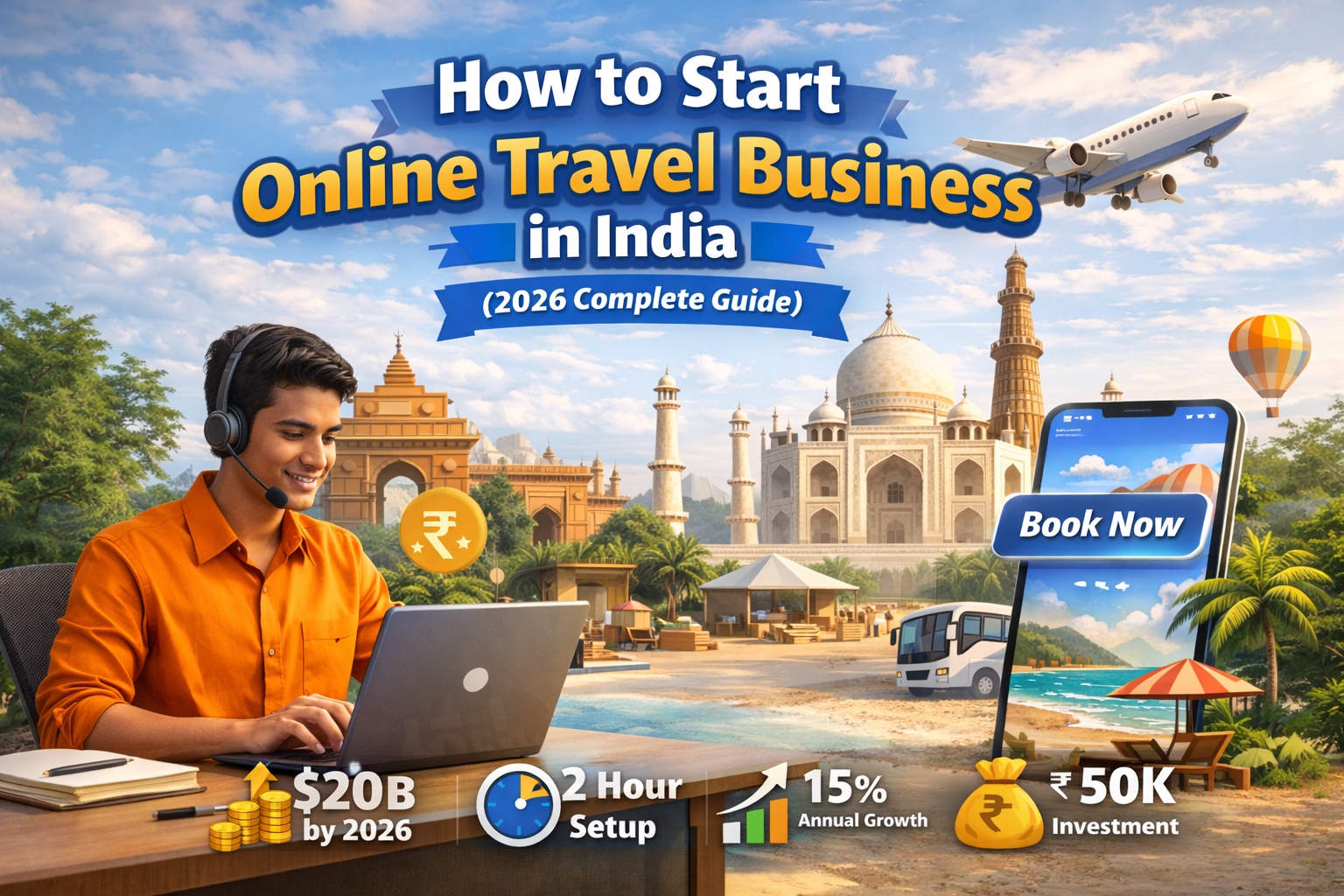
India's online travel business landscape is growing at roughly 15% a year and is projected to be worth $20 billion by 2026. Whether you want to run a consumer-facing booking site, build a network of agents, or both, this guide walks through every step of starting an online travel business in India — from choosing a model to registration, technology, investment, revenue and marketing.
On This Page
- Why Start an Online Travel Business in India?
- Step 1: Choose the Right Business Model
- Step 2: Register Your Travel Business in India
- Step 3: Set Up Technology & APIs
- Step 4: Investment & Cost Breakdown
- Step 5: Revenue Sources
- Step 6: Marketing & SEO Strategy
- Common Mistakes to Avoid
- Frequently Asked Questions
Why Start an Online Travel Business in India in 2026?
The online travel business in India is booming. With a growing middle class, affordable domestic flights, increased smartphone usage, and the rise of UPI payments, more Indians are booking travel online than ever before. This creates a massive opportunity for new travel entrepreneurs.
- India's travel market is one of the fastest-growing in the world
- Low-cost carriers have made air travel accessible to millions
- Over 700 million smartphone users booking travel on mobile
- UPI and digital wallets have simplified online payments
- Demand for hotels, holiday packages and bus travel is at an all-time high
- Rising outbound international travel from the Indian middle class
Step 1: Choose the Right Business Model for Your Online Travel Business in India
Before you invest a single rupee, you must decide which travel business model you want to run. Each model has different target audiences, revenue streams and investment requirements.
B2C Travel Portal (Business to Customer)
A B2C travel portal allows end customers to directly search and book flights, hotels, buses and holiday packages on your website. You earn revenue through markups and service fees on each booking.
Best for: Entrepreneurs who want to build a consumer travel brand like MakeMyTrip or Yatra at a smaller scale.
- Direct revenue per booking
- Build your own customer base
- Higher markup control
- Requires marketing budget to attract customers
B2B Travel Portal (Business to Business)
A B2B travel portal connects you with a network of travel agents and sub-agents who book travel services through your platform using a credit/wallet system. You earn commissions from agent bookings.
Best for: People who have connections in the travel agent community or want to build a large agent network.
- Agents bring their own customers — less marketing needed
- High booking volumes from multiple agents
- Scalable agent commission model
- Requires onboarding and managing agents
White Label Travel Portal
A white label travel portal is a ready-made travel booking platform that is fully branded with your company name, logo and domain. The backend technology, APIs, and maintenance are handled by the provider (like Rayds), while you focus on sales and growing your business.
Best for: First-time entrepreneurs who want to launch an online travel business in India quickly, with minimal investment and no technical knowledge.
- Launch in just 2 hours — no development time
- 70–80% lower cost than custom development
- Includes flights, hotels, buses, holidays and more
- Full B2B + B2C combined system available
- No coding or technical skills required
| Feature | B2C Portal | B2B Portal | White Label Portal |
|---|---|---|---|
| Target Audience | End Customers | Travel Agents | Both |
| Investment | High | Medium | Low (Rs.50K+) |
| Launch Time | 3–6 months | 3–6 months | 2 Hours |
| Technical Skills | Required | Required | Not Required |
| Revenue Model | Markup + Fees | Commissions | Both |
| Best For | Funded Startups | Agent Networks | Beginners |
Step 2: Register Your Online Travel Business in India
Before launching your portal, you need proper business registration. Here are the essential registrations for an online travel business in India:
Mandatory Registrations
- GST Registration — Required for all businesses with turnover above Rs.20 lakhs. Travel agencies need GST to issue proper invoices and collect taxes.
- PAN Card — Mandatory for all business financial transactions and tax filing.
- Current Bank Account — A business current account is required to receive payments from customers and payment gateways.
Recommended Registrations
- Private Limited Company or LLP — Gives your business legal credibility, especially when signing API agreements with airlines and hotels.
- MSME Registration — Free registration that provides access to government schemes and subsidies for small businesses.
- IATA Accreditation — Optional but gives you access to better airline commission rates. Not required to start.
Step 3: Set Up Technology & APIs for Your Travel Portal
Technology is the backbone of any online travel business in India. You need reliable APIs for flights, hotels and buses, a secure payment gateway, and a user-friendly booking interface.
Flight Booking API
Connects your portal to real-time airline inventory. Options include GDS systems (Amadeus, Sabre, Galileo) or LCC aggregators. With a white label portal, these are pre-integrated — you don't need to negotiate API contracts yourself.
Hotel Booking API
Gives access to 500,000+ hotel properties worldwide with live pricing and instant confirmation. Providers include Hotelbeds, RateHawk, and Agoda B2B — all pre-integrated in a white label solution.
Payment Gateway Integration
Essential for accepting online payments. In India, you need support for UPI, net banking, credit/debit cards, and digital wallets. Popular options include Razorpay, PayU, and CCAvenue.
Admin Dashboard
A control panel where you manage bookings, agents, markups, commissions, refunds and reports. This is where you run your entire business from — no coding required.
Step 4: Cost to Start an Online Travel Business in India
One of the most common questions is: "How much money do I need to start an online travel business in India?" The answer depends on which path you choose.
| Cost Component | White Label Portal | Custom Development |
|---|---|---|
| Portal Development | Rs.50,000 – Rs.2,00,000 | Rs.5,00,000 – Rs.20,00,000 |
| API Integration | Included | Rs.1,00,000 – Rs.5,00,000 |
| Payment Gateway Setup | Included | Rs.10,000 – Rs.50,000 |
| Domain + Hosting | Rs.2,000 – Rs.10,000/yr | Rs.20,000 – Rs.1,00,000/yr |
| Launch Time | 2 Hours | 3–6 Months |
| Annual Maintenance | Included in plan | Rs.1,00,000 – Rs.5,00,000 |
| Total Startup Cost | Rs.52,000 – Rs.2,10,000 | Rs.7,00,000 – Rs.26,00,000+ |
For most first-time entrepreneurs starting an online travel business in India, a white label solution offers the best return on investment — lower cost, faster launch, and all technology maintained by experts.
Step 5: Revenue Sources for Your Travel Business
A well-structured online travel business in India can generate revenue from multiple streams simultaneously:
| Revenue Source | Typical Margin | Notes |
|---|---|---|
| Domestic Flight Bookings | 2–5% | High volume, consistent income |
| International Flights | 3–8% | Higher margin per ticket |
| Hotel Bookings | 10–20% | Best margin product |
| Bus Bookings | 5–10% | High volume in Tier 2/3 cities |
| Holiday Packages | 15–25% | Highest margin, customizable |
| B2B Agent Commissions | 1–3% | Passive income from agent network |
| Travel Insurance | 20–30% | High margin, low effort |
| Service/Convenience Fees | Fixed per booking | Pure profit, non-refundable |
Step 6: Marketing & SEO Strategy for a Travel Business in India
Having a travel portal is not enough — you need customers. Here is how to market your online travel business effectively in India:
1. Search Engine Optimization (SEO)
Write blog articles targeting keywords like "cheap flights from Mumbai," "best hotels in Goa," and "how to book bus tickets online in India." SEO brings free, long-term organic traffic to your portal.
2. Google Ads (Fastest Way to Get Customers)
Google Ads places your portal at the top of search results immediately. Start with a budget of Rs.5,000–15,000 per month targeting high-intent keywords like "flight booking India" and "hotel booking online."
3. WhatsApp Marketing
Travel is a personal purchase. WhatsApp broadcasting to existing and potential customers with flight deals, holiday packages and last-minute offers is highly effective in India.
4. Social Media (Instagram & Facebook)
Post travel content, destination photos, and offer announcements. Run targeted Facebook Ads to specific cities or demographics interested in travel.
5. B2B Agent Network
The fastest way to scale — onboard travel agents in Tier 2 and Tier 3 cities who don't have their own portals. They get a booking platform, you get consistent booking volume.
Ready to Start Your Online Travel Business in India?
Launch your fully branded online travel portal with flights, hotels, buses and holiday packages in just 2 hours. Trusted by 800+ travel agencies across India.
Get Free Demo View White Label PortalCommon Mistakes to Avoid When Starting a Travel Business in India
- Ignoring SEO — Most travel bookings start with a Google search. No SEO means no organic customers.
- Building a custom portal too early — Spending months and lakhs on custom development before validating the business idea. Always start with a white label portal.
- Slow website — A slow travel portal loses customers instantly. Ensure your portal loads in under 3 seconds.
- No payment gateway backup — If your primary payment gateway is down, you lose bookings. Always have a secondary gateway.
- Ignoring mobile users — Over 70% of travel searches in India happen on mobile. Your portal must be fully mobile responsive.
- Poor customer support — Travel is time-sensitive. No WhatsApp/email support means bad reviews and no repeat customers.
Frequently Asked Questions About Starting an Online Travel Business in India
Conclusion: Starting Your Online Travel Business in India
Starting an online travel business in India in 2026 is a high-potential opportunity — but success depends on choosing the right model, technology, and marketing strategy from Day 1.
For most first-time travel entrepreneurs, a white label travel portal is the smartest starting point. It eliminates the high cost and long timelines of custom development, gives you a fully branded, professional booking platform, and lets you start generating revenue within hours — not months.
With the right portal, consistent marketing, and a growing agent network, building a Rs.10–50 lakh annual revenue travel business in India is very achievable within 12–18 months.
Ready to take the first step? Get a free demo of Rayds' white label travel portal today.