Top Features Every Successful AEPS Banking Platform Must Have
💡 Did You Know?
AEPS enables banking services without requiring debit cards or internet banking credentials.
The banking industry has evolved rapidly with digital technologies making financial services
more accessible across urban and rural regions. The Aadhaar Enabled Payment System
(AEPS) has become one of the most important banking innovations by allowing users
to access financial services using Aadhaar authentication and biometric verification. Customers
no longer need debit cards or internet banking credentials to perform basic banking activities.
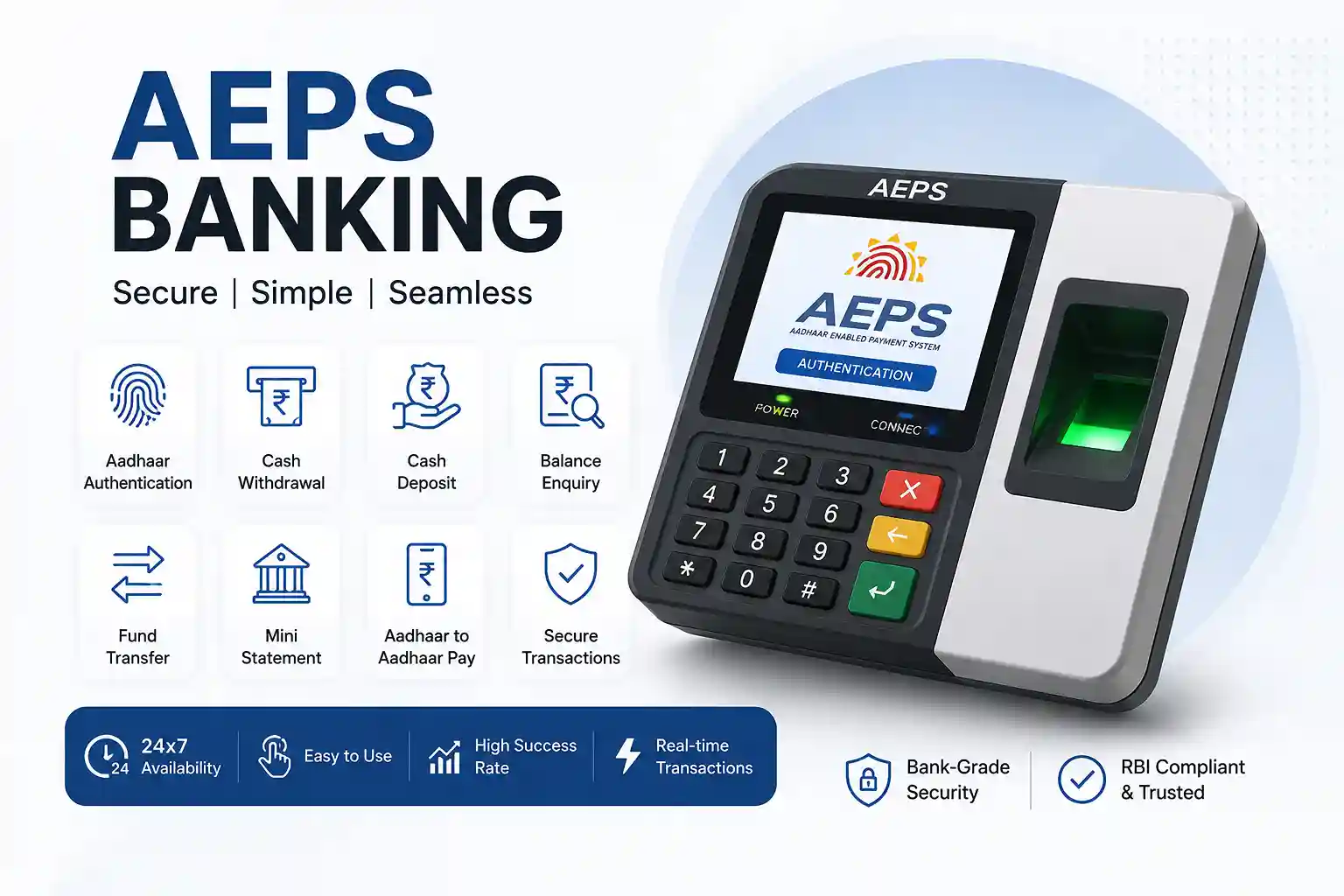
A modern AEPS banking platform should provide a complete ecosystem that
supports cash withdrawals, balance enquiries, mini statements, fund transfers, and secure
Aadhaar-based authentication. Businesses operating banking platforms also require retailer
modules, commission systems, analytics dashboards, and transaction management solutions to scale
efficiently.
Modern fintech ecosystems frequently integrate AEPS with services such as Money Transfer systems, UPI QR Payments, BBPS Payment platforms, and Mobile
Recharge services. Combining multiple financial solutions under one ecosystem improves
user engagement and increases repeat usage.
If you are planning to build an Aadhaar banking ecosystem, below are the key features every
successful AEPS platform should include.
How AEPS Works
1
Aadhaar Entry
2
Biometric Authentication
3
Bank Verification
4
Transaction Success
1. Aadhaar Authentication Integration
AEPS operates through Aadhaar-based authentication and biometric verification. Secure API
integrations allow customers to access banking services instantly without relying on debit cards
or banking credentials.
Aadhaar Authentication Integration enables businesses and service providers to verify a user's
identity securely using Aadhaar-based authentication methods such as biometric, OTP, or
demographic verification. By integrating Aadhaar authentication APIs, organizations can
streamline customer onboarding, enhance security, and ensure compliance with regulatory
requirements.
This integration is widely used in banking, fintech, AEPS, eKYC, and government services to
provide fast, reliable, and paperless identity verification while delivering a seamless user
experience.
2. Cash Withdrawal Support
Cash withdrawal remains one of the most frequently used AEPS services. Users should be able to
withdraw money securely using Aadhaar verification and biometric authentication.
Cash Withdrawal Support is a key service under systems like National Payments Corporation of
India enabled banking, allowing users to withdraw money directly from their bank account using
Aadhaar authentication and biometric verification.
It is mainly used in AEPS and micro-ATM networks to provide banking access in rural and
semi-urban areas where traditional ATMs or bank branches may not be easily available.
3. Balance Enquiry Feature
The Balance Enquiry feature is an essential service in systems like AEPS (Aadhaar Enabled
Payment System) that allows users to instantly check their bank account balance using
Aadhaar-based authentication.
This service is commonly provided through micro-ATMs and banking agents, enabling
customers—especially in rural and semi-urban areas—to access banking information without
visiting a bank branch or using a debit card.
It Matters
Balance Enquiry improves financial accessibility by giving users quick visibility of their
funds, helping them manage daily transactions and cash flow more effectively, especially in
underserved regions.
4. Mini Statement Generation
Mini statements allow users to review recent banking activities without visiting bank branches.
Easy access to account history improves financial visibility and user convenience.
It is a core feature in AEPS (Aadhaar Enabled Payment System) that allows customers to view a
summary of their recent bank transactions using Aadhaar-based authentication.
It helps users quickly check their account activity without visiting a bank branch, ATM card, or
internet banking facility.
5. Multi-Bank Support
Multi-Bank Support is a key feature in AEPS and Aadhaar-based payment systems that allows users
to access and perform banking transactions across multiple banks using a single Aadhaar number.
Instead of being limited to one bank, customers can select their linked bank at the time of
transaction and carry out services like cash withdrawal, balance enquiry, or mini statement
seamlessly. This interoperability ensures greater flexibility, wider accessibility, and improved
convenience, especially for users in rural and semi-urban areas, while promoting smooth
integration across the banking network in systems managed by the National Payments Corporation
of India.
AEPS at a Glance
🔒
100%
Secure Transactions
6. Real-Time Transaction Tracking
Real-Time Transaction Tracking is a feature in AEPS and digital banking systems that allows
users and service providers to instantly monitor the status of financial transactions as they
happen. It provides live updates on activities such as cash withdrawals, balance enquiries, and
fund transfers, ensuring transparency and accuracy in every transaction. This feature helps
detect success, pending, or failed transactions immediately, reducing disputes and improving
customer trust. It is widely used in systems operated under the National Payments Corporation of
India network to ensure secure and seamless banking experiences across all AEPS-enabled
platforms.
7. Retailer & Distributor Module
Retailer & Distributor Module is a structured management system used in AEPS and digital payment
platforms that allows efficient handling of multiple agent levels such as retailers,
distributors, and super distributors. It helps in user onboarding, commission management,
transaction monitoring, wallet management, and service distribution across different hierarchy
levels. This module ensures smooth operation of AEPS services by enabling controlled access,
real-time reporting, and automated settlement of commissions, making it easier for businesses to
scale their banking and financial service network efficiently under systems aligned with the
National Payments Corporation of India ecosystem.
8. Commission Management System
Commission Management System is a core feature in AEPS and fintech platforms that automatically
calculates, tracks, and distributes commissions across different user levels such as retailers,
distributors, and super distributors. It ensures transparent and accurate earnings for every
transaction like cash withdrawal, balance enquiry, or money transfer by applying predefined
commission rules. The system also provides real-time reports, wallet updates, and settlement
tracking, helping businesses manage payouts efficiently while maintaining clarity and trust
within the network operating under the National Payments Corporation of India framework.
9. Analytics Dashboard
Analytics Dashboard is a centralized reporting interface used in AEPS and fintech platforms to
monitor, analyze, and visualize all transaction activities in real time. It provides detailed
insights such as transaction volume, success and failure rates, revenue, commission earnings,
user activity, and geographic performance of retailers and distributors. With interactive charts
and summaries, it helps administrators make data-driven decisions, detect anomalies, and
optimize business performance. This dashboard plays a crucial role in improving transparency,
efficiency, and operational control within digital payment ecosystems operated under the
National Payments Corporation of India network.
10. Security & Fraud Protection
Security & Fraud Protection in AEPS and digital payment systems refers to a set of advanced
safeguards designed to ensure safe, encrypted, and trustworthy financial transactions. It
includes Aadhaar-based biometric authentication, real-time transaction monitoring, encryption of
sensitive data, device binding, and risk-based fraud detection systems that help prevent
unauthorized access and suspicious activities. These security layers continuously verify user
identity and transaction legitimacy to reduce fraud risks and protect customer funds. Such
mechanisms are widely implemented across platforms operating under the National Payments
Corporation of India ecosystem to ensure secure and reliable financial services across India.
Frequently Asked Questions
AEPS stands for Aadhaar Enabled Payment System which allows banking transactions
through Aadhaar authentication and biometric verification.
Yes. Users can withdraw cash securely through Aadhaar and biometric verification.
Yes. AEPS platforms generally support transactions across multiple banking
institutions.
Yes. Retailers can process banking services and earn commissions through dedicated
modules.
Yes. Modern AEPS systems use Aadhaar authentication, biometric verification,
encryption, and fraud monitoring technologies.
Launch Your AEPS Banking Platform
Build a complete Aadhaar banking ecosystem with withdrawals, mini statements,
retailer systems, secure APIs, and financial automation.
Request Demo