Why Most Travel Portals Fail (And How to Avoid It in 2026)
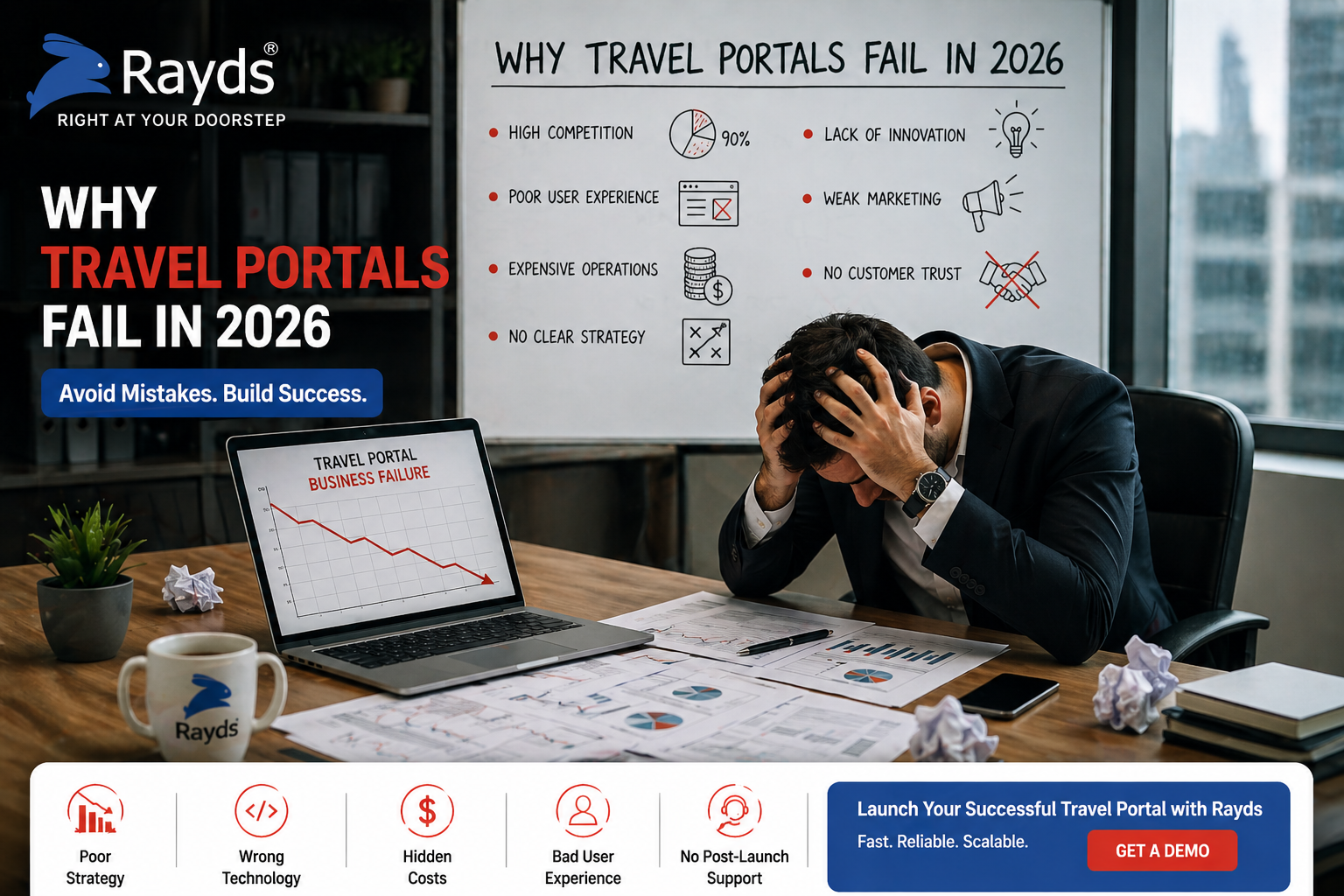
Launching a travel portal looks easy from the outside. You pick a domain, find a developer, add some flights and hotels — and wait for bookings to roll in. But the reality is far harsher.
Over 70% of travel portals shut down within the first 12 months. Not because the travel industry is shrinking — it's booming — but because founders make the same avoidable mistakes over and over again.
If you're planning to launch a white label travel portal, or even a custom-built platform, understanding these failure patterns can save you lakhs of rupees, months of wasted effort, and the pain of starting over.
This guide covers every major reason travel portals fail — backed by industry data, real patterns from the Indian travel market, and actionable fixes you can apply today.
The Indian Online Travel Market in 2026: Opportunity and Risk
India's online travel market crossed ₹2.4 lakh crore (≈ $29 billion) in 2025 and is projected to grow at a CAGR of 13–15% through 2030. Mobile bookings now account for over 65% of all transactions. Despite this massive opportunity, new travel portals continue to fail at alarming rates.
The problem is not market size — it's execution. Let's break down every reason portals fail, and more importantly, how to make sure yours doesn't.
Top 7 Reasons Why Travel Portals Fail in 2026
1. Choosing the Wrong Technology Partner ❌
This is the single biggest killer of travel portals. Many agency owners choose developers based on price alone — picking freelancers or low-cost studios who have never built a real booking system. The result: buggy search results, failed payment flows, slow API responses, and a portal that crashes during peak traffic like festival season.
A travel portal is not a regular website. It must handle real-time API calls to multiple inventory suppliers simultaneously, process secure financial transactions, manage booking status updates, and send automated confirmations — all within seconds.
- Cannot show you live portals they have built
- Promises delivery in 2–3 weeks for a full portal
- Has no experience with GDS or travel API integrations
- Offers a price that seems too good to be true
- Cannot explain how they handle payment failures or refunds
👉 Always choose a reliable travel portal development company with verifiable client references and live portals you can test.
2. No Clear Pricing and Markup Strategy 💸
Many travel portals go live without understanding how they will actually make money. They assume the API supplier will handle pricing — but suppliers provide net rates. You need a dynamic markup engine that adds your margin on top, without pricing yourself out of the market.
Without a markup strategy, portals either lose money on every booking, or overprice and lose customers to MakeMyTrip and Cleartrip. A structured approach includes:
- Base markup rules by route, category, and supplier
- Dynamic pricing adjustments during peak demand
- B2B vs B2C pricing tiers for agents and direct customers
- Promotional discount logic that doesn't eat into margins
👉 Check our detailed travel portal cost breakdown before launching so you can budget for the right tools.
3. Poor User Experience (UX) on Mobile 📉
In 2026, a travel portal with a bad mobile experience is dead on arrival. Over 65% of travel searches in India happen on smartphones — users on 4G connections who will abandon your site in seconds if it's slow or confusing.
Common UX failures include:
- Search results that take 8–12 seconds to load
- Filter and sort options that don't work on mobile
- Booking flows with too many steps (more than 4 is too many)
- No clear error messages when a booking fails
- Session timeouts that lose the customer's itinerary mid-booking
4. Lack of Essential API Integrations 🔌
A travel portal with only one flight supplier, no hotel inventory, and no bus booking cannot compete in today's market. Users expect to compare dozens of airlines, hundreds of hotels, and multiple bus operators — all in one place.
The essential API stack for a competitive travel portal in India:
| Service | API Options | Why It Matters |
|---|---|---|
| Flights | TBO, Amadeus, Sabre, Galileo | Real-time fare & seat availability |
| Hotels | Expedia, Hotelbeds, GiataHub | Global + domestic inventory |
| Bus | RedBus, AbhiBus | High-volume domestic segment |
| Payment | Razorpay, Paytm, PayU | UPI, cards, net banking |
| Insurance | Digit, Bajaj Allianz | Upsell revenue + trust |
| Visa | Atlys, iVisa | International travel upsell |
Portals that integrate 3+ services have significantly higher average order values and return visit rates compared to single-service portals.
5. Weak or Incomplete Payment System 💳
In India, a payment gateway that doesn't support UPI is missing the most popular payment method in the country. In 2025, UPI accounted for over 55% of all digital transactions. Travel portals that only offer card payments lose more than half their potential customers.
Beyond UPI, your payment system must handle:
- PCI-DSS compliant card processing
- Automatic refunds on cancellations
- Partial payments and EMI options for high-value bookings
- Wallet balance for B2B agents
- Multi-currency support for international bookings
- Failed payment retry flows with clear customer communication
6. Launching Without Any Marketing Strategy 🚫
The "build it and they will come" approach has never worked online, and it's even less effective in the hyper-competitive travel market. A portal without a marketing plan from Day 1 will burn through its budget without acquiring meaningful customers.
Effective marketing channels for travel portals in India:
Publish destination guides, route-specific content, and travel tips. Target long-tail keywords like "cheapest flights from Mumbai to Dubai" and "budget hotels in Manali."
Run Performance Max campaigns for flight routes and hotel destinations. Start with high-intent keywords. Track cost-per-booking carefully.
Build a WhatsApp broadcast list. Send fare alerts, flash deals, and holiday packages. Conversion rates on WhatsApp in India are 3–5x email.
Recruit travel agents in Tier 2 & 3 cities. One active B2B agent can generate the equivalent of 50+ direct customers per month.
Instagram and YouTube travel content drives brand awareness. Micro-influencers in travel niches deliver better ROI than celebrity endorsements.
7. Ignoring the B2B Agent Model 🚀
Most new travel portals focus entirely on B2C — targeting individual travelers directly. This is the hardest and most expensive customer acquisition model in travel.
The smarter play: launch a B2B sub-agent panel alongside your B2C portal. Travel agents across India are looking for reliable platforms to book through. One registered agent who books ₹5 lakh worth of travel per month is worth more than 200 individual walk-in customers — with zero additional marketing cost.
A B2B panel should offer:
- Custom markup settings per agent
- Prepaid wallet with credit limit management
- Co-branded booking vouchers
- Sales performance dashboard
- Dedicated support for agents
Custom Development vs White Label Travel Portal: Which Should You Choose?
One of the most consequential decisions you'll make is whether to build a custom travel portal or use a white label solution. Here's a detailed comparison:
| Factor | Custom Development | White Label (Rayds) |
|---|---|---|
| Time to Launch | 4–12 months | 2 hours |
| Cost | ₹5–25+ lakhs | Fraction of the cost |
| API Integrations | Built from scratch | Pre-integrated |
| Mobile Optimized | Depends on team | Yes, by default |
| B2B Panel | Extra cost + time | Included |
| Payment Gateway | Extra integration | Pre-configured |
| Risk of Failure | High | Low |
| Ongoing Maintenance | Your responsibility | Handled by Rayds |
| Scalability | Depends on architecture | Built to scale |
For most travel agencies, small tour operators, and entrepreneurs entering the travel space, a white label travel portal is the smarter, lower-risk choice — especially in 2026 when the market is moving fast.
Pre-Launch Checklist: Is Your Travel Portal Ready?
Before going live, run through this checklist. Every unchecked item is a risk.
- Flight API integrated and tested with live fares
- Hotel inventory connected with real-time availability
- Payment gateway live and tested (including UPI, cards, and net banking)
- Mobile experience tested on 5+ real devices
- Page load time under 3 seconds on 4G
- Booking confirmation emails and SMS configured
- Refund and cancellation flow tested end-to-end
- Google Analytics and Meta Pixel installed
- SSL certificate active (HTTPS)
- B2B sub-agent panel ready with at least 5 registered agents
- Basic SEO: sitemap, robots.txt, meta tags on all pages
- WhatsApp Business number connected for support
- At least one month of content (blog posts, destination guides) published
How to Measure Travel Portal Success (KPIs to Track)
Many portal owners don't know they're failing until it's too late because they aren't tracking the right metrics. Here are the KPIs that matter:
How to Avoid Travel Portal Failure: Complete Action Plan
- Choose a proven white label solution with live references you can verify
- Prioritize mobile performance — test on real phones, not just desktop Chrome DevTools
- Integrate multiple inventory APIs before launch, not after
- Define markup and pricing strategy before the first booking goes live
- Launch with SEO content — at least 10 destination/route articles on Day 1
- Enable B2B agent panel from the start — don't retrofit it later
- Set up retargeting ads to re-capture users who searched but didn't book
- Use WhatsApp for customer support — Indian customers expect fast responses
- Monitor Core Web Vitals weekly using Google Search Console
- Track your top 10 keywords and publish content targeting them monthly
Real Scenarios: Why Portals Fail at Different Stages
Stage 1 — Fails Before Launch
The agency spent 8 months and ₹12 lakhs building a custom portal. The developer couldn't integrate the flight API correctly. Payment gateway approval took 3 months. By the time they were ready to launch, their budget was exhausted and they couldn't afford marketing. Portal never went live.
Fix: Start with a white label solution. Launch fast, then iterate.
Stage 2 — Fails Within 3 Months of Launch
The portal launched on time. They ran Google Ads and got traffic. But the mobile booking experience was broken — the payment page didn't render properly on Android. 80% of visitors abandoned at checkout. Thousands of rupees spent on ads, zero bookings completed.
Fix: Mandatory mobile QA across 5+ real devices before any paid spend.
Stage 3 — Fails at 6–9 Months
Bookings were coming in, but the portal was priced too thin. The owner was matching MakeMyTrip prices without any markup strategy, losing ₹200–500 per booking after payment gateway fees. Six months in, they'd processed ₹40 lakhs in bookings — and lost money on every one.
Fix: Set markup rules by route and category before launch. Know your margin per booking.
The Best Solution to Avoid Travel Portal Failure in 2026
Instead of building from scratch and hoping for the best, the most successful travel agencies in India are now choosing ready-made white label travel portals that eliminate 90% of the risk from Day 1.
A production-ready white label portal from a reliable provider includes:
- Fast launch — go live in 2 hours
- Pre-integrated flight, hotel, and bus APIs
- Secure UPI and card payment system
- B2B sub-agent panel with wallet management
- Mobile-first, SEO-optimized frontend
- Admin panel with booking management
- Automated booking confirmations and vouchers
- Ongoing technical support and updates
Frequently Asked Questions
Related Articles
Start Your Travel Business Today
Launch your own travel portal with flights, hotels, buses, and fintech services. Go live in 2 hours.
Request Free Demo View Pricing