Online Travel Business vs Offline Travel Agency — Which Is Right for You in 2026?
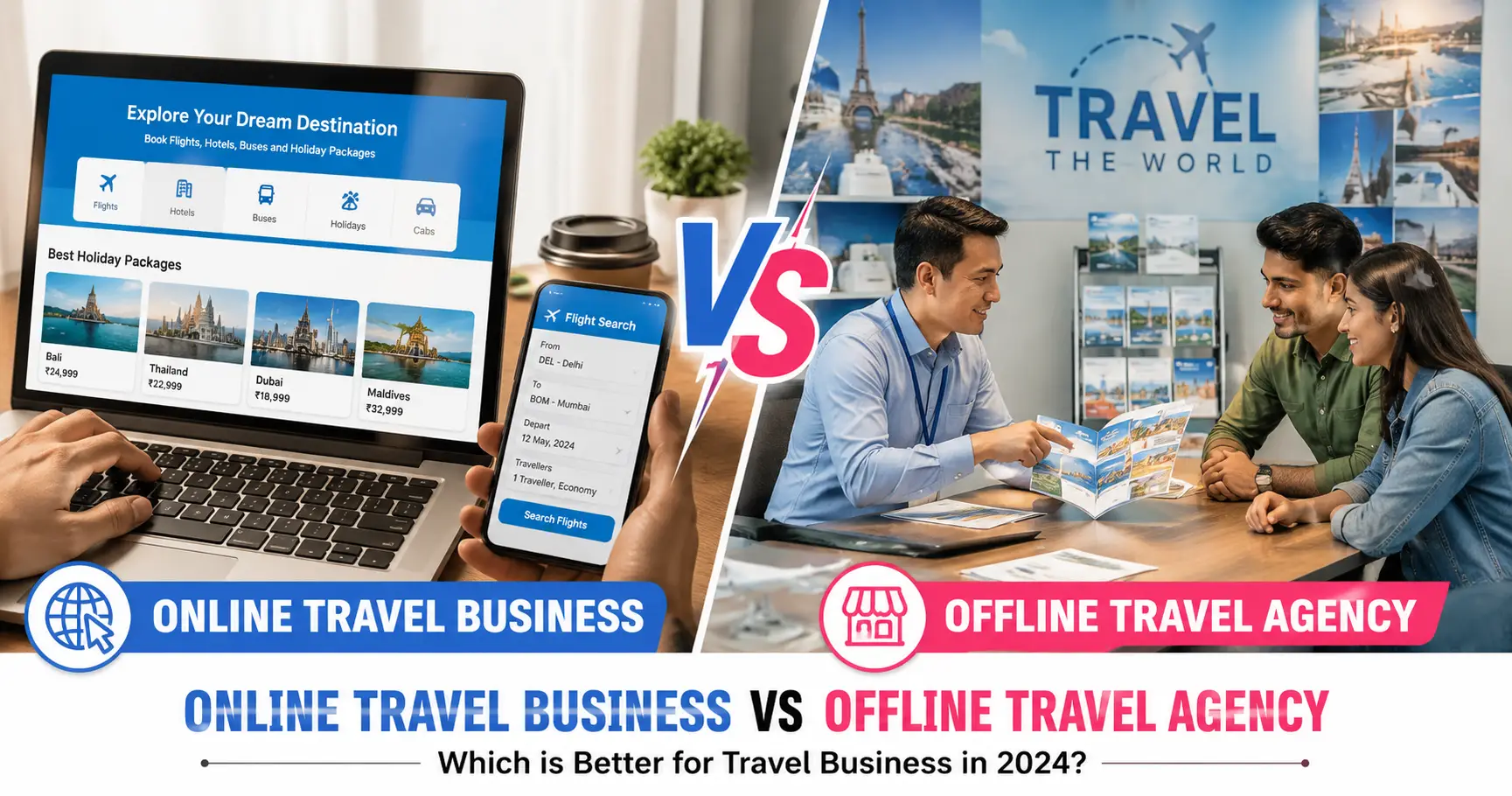
⚡ Quick Answer: Online vs Offline Travel Business
Both models are profitable in India — but they serve different goals, audiences, and budgets.
- Online Travel Business: Lower startup cost (₹15K–₹5L), national reach, 24/7 bookings, best for scale
- Offline Travel Agency: High trust, premium margins, best for corporate & group travel
- Hybrid Model: The most profitable approach in 2026 — run both together
India's travel industry is undergoing a massive digital shift. Over 70% of travel bookings in India are now made online, yet thousands of offline travel agencies continue to thrive — especially in tier 2 and tier 3 cities, corporate travel, and luxury holiday packages.
So which model should you start or shift to in 2026? In this guide, we break down every key difference between an online travel business and an offline travel agency — from startup costs and profit margins to customer reach and scalability — so you can make the right decision for your budget and goals.
1. What Is an Online Travel Business?
An online travel business operates primarily through a digital platform — a travel portal, website, or mobile app — where customers can search, compare, and book flights, hotels, buses, trains, holiday packages, and visa services without visiting a physical office.
In India, online travel businesses range from individual travel agents running a white label portal to full-scale OTAs (Online Travel Agencies) like MakeMyTrip, Yatra, and EaseMyTrip. The key driver is technology: APIs connect the portal to real-time inventory, and payment gateways allow instant transactions around the clock.
🛒 B2C Online Travel Portal
Sells directly to consumers. Works like MakeMyTrip — customers self-book. Best for high-volume, low-margin domestic travel.
🤝 B2B Online Travel Portal
Sells to travel agents and sub-agents. Agents book through your platform and earn commissions. Best for building a large distribution network.
🔄 B2B2C Hybrid Portal
Serves both consumer and agent markets from one platform. The most common and scalable model for Indian travel businesses in 2026.
🏢 B2E Corporate Portal
Managed travel for corporate clients. Includes policy controls, expense reports, and dedicated support. High-value, recurring revenue model.
2. What Is an Offline Travel Agency?
An offline travel agency operates from a physical office where customers walk in, consult with a travel expert, and book their trips. The agent manually researches options, contacts airlines or hotels, prepares itineraries, and processes payments — often via cheque, NEFT, or card swipe.
Offline agencies typically specialise in areas where personal expertise creates real value: complex international itineraries, corporate travel management, group pilgrimages, luxury holidays, and visa assistance. Their strength is trust, relationships, and personalised service.
3. Startup Cost Comparison
Startup cost is one of the biggest differentiators between the two models. Here is a full breakdown of what you need to invest to launch each type of travel business in India in 2026:
| Cost Item | Online Travel Business | Offline Travel Agency |
|---|---|---|
| Office / Premises | Not Required | ₹10,000 – ₹50,000/month rent |
| Portal / Website Setup | ₹15,000 – ₹5,00,000 | ₹5,000 – ₹20,000 (basic website) |
| API Integration | ₹20,000 – ₹3,00,000+ | Not Required (manual booking) |
| API Security Deposit (Refundable) | ₹50,000 – ₹5,00,000 | Not Required |
| Office Furniture & Equipment | Not Required | ₹30,000 – ₹1,50,000 |
| Staff Salaries / Month | ₹0 – ₹40,000 (small team) | ₹30,000 – ₹1,50,000 (2–4 staff) |
| IATA / TAAI Membership | Optional (₹10,000–₹50,000/yr) | Recommended (₹10,000–₹50,000/yr) |
| Marketing (Month 1) | ₹10,000 – ₹1,00,000 (digital) | ₹5,000 – ₹30,000 (local) |
| GST Registration | ₹3,000 – ₹10,000 | ₹3,000 – ₹10,000 |
| Estimated First-Year Total | ₹1,00,000 – ₹15,00,000 | ₹2,00,000 – ₹8,00,000 |
4. Revenue & Profit Margins
Revenue potential varies significantly between models — not just in amount, but in how money is earned. Online portals earn at scale through volume; offline agencies earn through margin and relationships.
| Revenue Stream | Online Business Margin | Offline Agency Margin |
|---|---|---|
| Domestic Flights | ₹50 – ₹300 per booking | ₹100 – ₹500 per booking (service fee) |
| International Flights | ₹500 – ₹2,000 per booking | ₹1,500 – ₹5,000 per booking |
| Hotel Bookings | 10% – 30% of room rate | 15% – 35% of room rate (direct contract) |
| Holiday Packages | 15% – 30% of package value | 20% – 40% of package value |
| Corporate Travel Management | 1% – 3% management fee | 3% – 8% management fee |
| Visa Services | ₹500 – ₹2,000 per applicant | ₹1,000 – ₹5,000 per applicant |
| Travel Insurance | 10% – 20% commission | 15% – 25% commission |
| B2B Agent Markup Revenue | 1% – 5% on all agent bookings | Not applicable |
| Convenience / Service Fees | ₹50 – ₹500 per booking | ₹200 – ₹1,000 per booking |
5. Customer Reach & Scalability
This is where online and offline models diverge most sharply. Customer reach determines the ceiling of your business growth.
| Factor | Online Travel Business | Offline Travel Agency |
|---|---|---|
| Geographic Reach | Pan-India and international | Local / city-level |
| Availability | 24/7, 365 days a year | Office hours only (typically 10 AM – 7 PM) |
| Customer Acquisition | SEO, Google Ads, Meta Ads, OTAs | Walk-ins, referrals, word of mouth |
| Scalability | Highly scalable (add agents, products, regions) | Limited by office capacity and staff |
| Booking Speed | Instant (automated) | Manual (minutes to hours) |
| Repeat Customer Rate | Moderate (loyalty programs help) | High (personal relationships) |
| B2B Network Building | Excellent (sub-agent portals) | Good (personal relationships) |
| International Customers | Easy to target | Very limited |
6. Pros & Cons: Full Breakdown
- No office rent or physical infrastructure needed
- 24/7 booking capability without staff presence
- Pan-India and global customer reach
- Scalable — add agents, modules, and products instantly
- Lower cost per booking as volume grows
- Data analytics to understand customer behaviour
- B2B sub-agent network multiplies revenue without extra cost
- Faster break-even period (2–5 months typically)
- Higher initial tech and API investment
- Requires digital marketing budget to generate traffic
- Lower trust for high-value bookings without brand recognition
- Technical maintenance and uptime dependency
- Customer service can be harder to personalise at scale
- Intense competition from MakeMyTrip, Yatra, and similar OTAs
- Refund and cancellation management can be complex
- High customer trust — face-to-face interactions
- Higher margins on premium and complex itineraries
- Dominant for corporate accounts and group travel
- Strong repeat business through personal relationships
- Easier to upsell add-ons (insurance, visa, activities)
- No dependency on digital traffic or SEO
- Preferred by senior and tier 2/3 city customers
- High fixed overheads (rent, salaries, utilities)
- Limited to local geographic market
- Cannot accept bookings outside office hours
- Difficult to scale without opening more offices
- Vulnerable to economic disruptions (COVID impact was severe)
- Slower booking process reduces customer satisfaction
- Younger customers increasingly prefer online self-service
7. Head-to-Head Comparison Table
| Factor | 🌐 Online Travel Business | 🏪 Offline Travel Agency |
|---|---|---|
| Startup Cost | ₹15,000 – ₹5,00,000 | ₹1,00,000 – ₹5,00,000 |
| Monthly Overheads | ₹5,000 – ₹40,000 | ₹40,000 – ₹2,00,000 |
| Geographic Reach | National + International | Local / Regional |
| Availability | 24/7 / 365 | Office Hours Only |
| Booking Speed | Instant | Manual (minutes–hours) |
| Scalability | High | Limited |
| Customer Trust | Moderate | High |
| Profit Margin per Booking | Lower (volume-based) | Higher (relationship-based) |
| Marketing Method | Digital (SEO, Ads) | Local referrals, walk-ins |
| Corporate Travel | Good (with B2E portal) | Excellent |
| Holiday Packages | Good | Excellent (customised) |
| Domestic Flights | Excellent | Good |
| B2B Agent Network | Excellent (sub-agent panels) | Good (manual) |
| Data & Analytics | Comprehensive | Minimal |
| Risk Level | Low–Medium | Medium–High (fixed costs) |
| Break-Even Period | 2–6 months | 6–18 months |
| COVID-19 / Crisis Resilience | High (low fixed cost) | Low (high fixed cost) |
| Best For | Scale, volume, national market | Premium, trust, local market |
8. The Hybrid Model: Best of Both Worlds
The most successful travel businesses in India in 2026 are running a hybrid model — combining the trust of a physical office with the scale and efficiency of an online portal. This is especially effective for mid-size travel agencies looking to grow without abandoning their existing client base.
How a Hybrid Travel Business Works
Handles walk-in customers, corporate accounts, group tours, visa applications, and premium holiday packages where personal consultation adds value.
Handles domestic flight and hotel bookings, B2B sub-agent network, and 24/7 self-service bookings. Generates volume revenue without additional staff.
Serve existing customers via WhatsApp for quick bookings, itinerary sharing, and confirmations — the fastest-growing customer touchpoint in India in 2026.
Optional for advanced hybrid businesses. Customers can self-book, track itineraries, and access support — improving retention and repeat bookings by 30–50%.
9. Which Should You Choose? Decision Guide
Use this decision framework to determine the right model for your specific situation:
| Your Situation | Recommended Model | Why |
|---|---|---|
| First-time travel entrepreneur with budget under ₹1L | Online Portal | Lower overhead, faster ROI, no physical infrastructure needed |
| Existing travel agent moving from manual to digital | Hybrid | Keep existing clients, add online revenue stream without disruption |
| Focusing on corporate travel & group tours | Offline + B2E Portal | Corporate clients prefer trust, dedicated account managers, and contracts |
| Building a B2B agent distribution network | Online B2B Portal | Sub-agent panels scale revenue without proportional staff increase |
| Tier 2 / Tier 3 city with established local trust | Hybrid | Local trust + online portal to capture regional and national demand |
| Premium luxury and international holiday specialist | Offline + Website | High-value clients prefer phone and in-person consultation |
| Large agency seeking OTA-scale growth | Online Enterprise Portal | Full OTA platform with mobile apps, B2B2C, and dedicated server |
✅ Our Verdict
For most Indian travel entrepreneurs in 2026, the best decision is to start online with a white label travel portal (₹50,000–₹1,50,000), then expand into a hybrid model as revenue grows. This gives you the fastest path to profit, the lowest risk, and the ability to serve both digital-first and traditional customers from day one.
10. 2026 Trends Shaping Both Models
Whether you go online, offline, or hybrid, these key trends will define which businesses succeed in India's travel industry in 2026 and beyond:
🤖 AI-Powered Travel Assistants
AI chatbots handle queries, suggest packages, and process bookings automatically — reducing staffing costs for both online and offline businesses by 30–50%.
💬 WhatsApp Commerce
WhatsApp Business API-powered booking flows are transforming how tier 2 and tier 3 city customers interact with travel agencies — both online and offline.
🏔️ Experiential & Sustainable Travel
Demand for unique, experience-driven travel (adventure, wellness, eco-tourism) is rising sharply — an opportunity where offline expertise adds more value than automated online booking.
🎫 BNPL for Travel
Buy Now Pay Later options (via Zest Money, LazyPay, HDFC Flexipay) are increasing average booking values by 25–40% on both online portals and offline agency transactions.
📊 Data-Driven Personalisation
Online portals using CRM and booking history data to personalise offers are seeing 20–35% higher repeat booking rates compared to generic search-and-book portals.
🌏 Outbound Travel Boom
India's outbound travel market is projected to grow 18% annually through 2028 — benefiting both online portals (international flight and hotel APIs) and offline luxury specialists.
📊 Summary: Total First-Year Cost Comparison
| Cost Component | Online Travel Business | Offline Travel Agency | Hybrid Model |
|---|---|---|---|
| Setup / Development | ₹15,000 – ₹5,00,000 | ₹50,000 – ₹2,00,000 | ₹1,50,000 – ₹6,00,000 |
| API Integration | ₹20,000 – ₹3,00,000 | Not required | ₹20,000 – ₹3,00,000 |
| Monthly Fixed Overheads | ₹5,000 – ₹40,000/month | ₹40,000 – ₹2,00,000/month | ₹50,000 – ₹2,50,000/month |
| Marketing (Year 1) | ₹60,000 – ₹5,00,000 | ₹30,000 – ₹2,00,000 | ₹80,000 – ₹5,00,000 |
| API Security Deposits (Refundable) | ₹50,000 – ₹5,00,000 | Not required | ₹50,000 – ₹5,00,000 |
| Estimated Total First Year | ₹1,50,000 – ₹15,00,000 | ₹5,00,000 – ₹25,00,000 | ₹6,00,000 – ₹30,00,000 |
| Expected Monthly Net Profit (Year 2) | ₹60,000 – ₹5,00,000+ | ₹50,000 – ₹3,00,000 | ₹2,00,000 – ₹8,00,000+ |
❓ Frequently Asked Questions
Ready to Start Your Travel Business?
Whether you want an online travel portal, a hybrid setup, or a B2B agent network — get a free consultation and custom demo from our travel technology experts.
Request Free Demo → See Portal Costs →